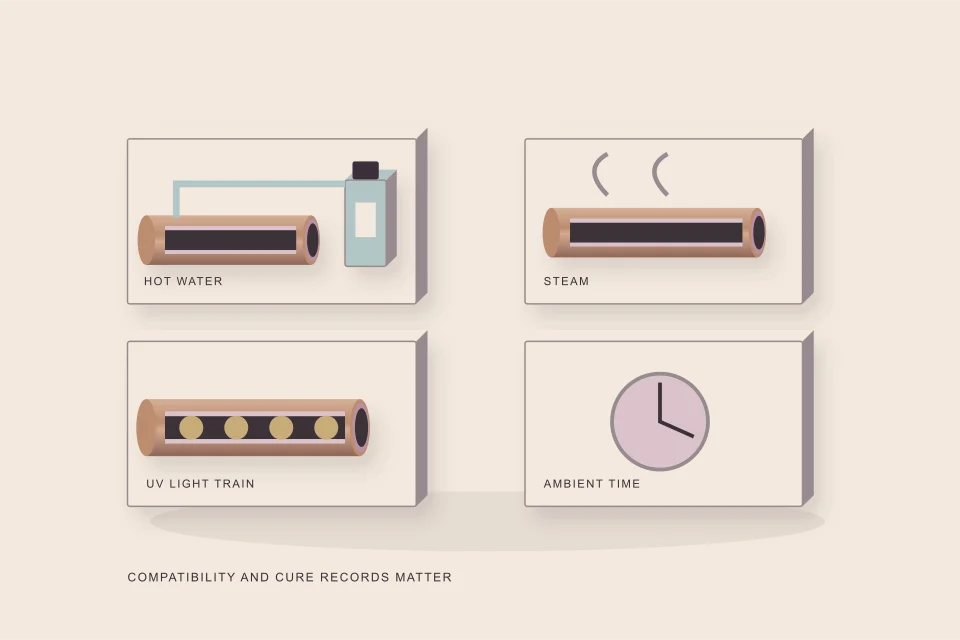
Curing is the step that turns a wet resin tube into a rigid pipe. ASTM F1216 and F1743 describe three ways: circulating hot water, introducing controlled steam, or a photo-initiated reaction. UV-cured glass-fibre liners follow ASTM F2019, with a lamp train pulled through the inflated tube. Some epoxy and silicate systems cure at ground temperature without added heat. The resin decides the cure.
- Heat cures circulate hot water or steam through the pressurised liner; the liner is cooled before pressure comes off.
- UV cures pull a lamp train through a glass-fibre liner held open by air, curing it behind the lamps.
- Ambient cures add no heat; the cure time depends on the resin and the ground temperature.
- Every cure should leave a record: temperatures and times, or lamp power and speed.
- Styrene odour comes from the resin, and NIOSH has measured styrene during UV installations too.
01 /What does curing actually do?
Curing triggers the chemical reaction that cross-links the resin from a liquid into a solid network. Until it happens the liner is a soft, wet tube held in shape only by the pressure inside it. After it, the resin and tube form a rigid composite wall. The Iowa SUDAS manual describes the heat-cure version: the applied heat causes the thermosetting resin in the felt to cure, changing it from a liquid to a solid, after which the liner is cooled.
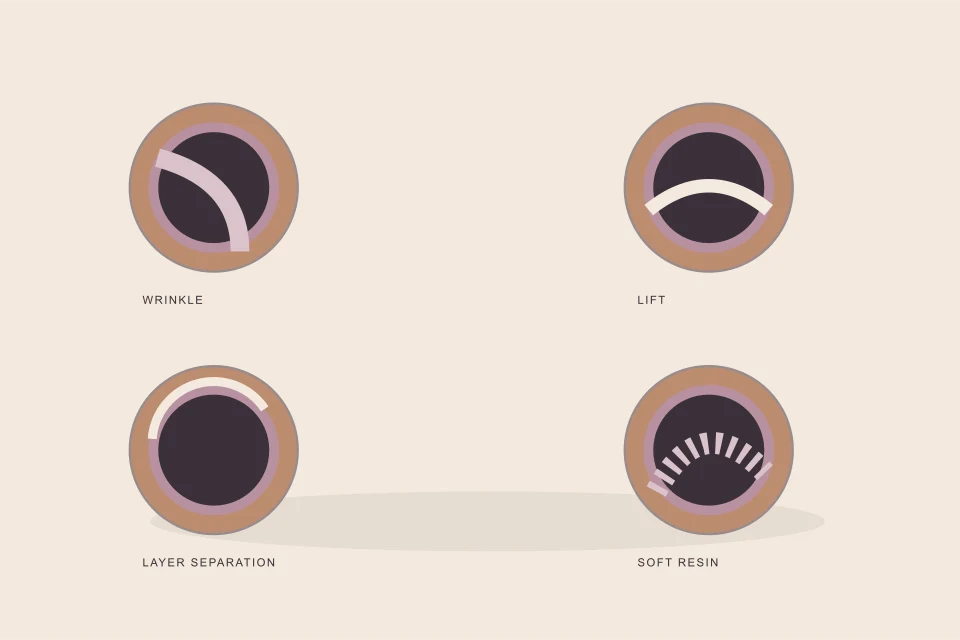
Two things must be true during the whole cure. The tube must stay pressed against the host pipe, which is why pressure is held throughout, and the entire length and thickness must reach the conditions the resin needs. A spot that stays too cool, or a lamp run too fast, leaves resin that is soft or tacky: the uncured-resin defect described in CIPP liner failures.
02 /How does a hot-water cure work?
In a hot-water cure, water inside the liner is heated and circulated until the resin reaches its cure temperature, held there for the time the system requires, then cooled. With water inversion the same water that turned the tube inside out becomes the heating medium; SUDAS describes curing typically by heating and circulating the water used to invert and expand the tube. A boiler unit at the access point supplies the heat, with hoses running to the far end so water can circulate.
Hot water holds heat well and presses evenly on the liner, which makes it forgiving on large and long runs. The drawbacks are volume and time: the pipe is filled with water that must be heated, then cooled, then drained and disposed of as the owner’s rules require. On a house lateral, hot water is used, but air inversion with steam or ambient cure is also common because of the smaller scale.
03 /How does a steam cure work?
A steam cure introduces controlled steam into a liner that has been inverted or inflated with air. Steam carries a lot of heat for its weight, so it heats the liner quickly, and condensate is drained from the low end. ASTM F1216 and F1743 both list controlled steam as a cure method. Steam is often paired with air inversion because the liner is already full of air rather than water.
Speed is steam’s strength, and control is its challenge: temperature must be kept even along the liner, with sensors at points the installer can read, and condensate must not pool where it cools the invert. With a styrene-based resin, the exhaust and condensate venting at the access points can carry the odour, so ask where they will discharge.
04 /How does a UV cure work?
An ultraviolet cure uses light instead of heat. ASTM F2019 describes a glass-reinforced tube, impregnated with a photo-initiated resin, pulled into the host pipe and inflated with compressed air, then cured by UV light. A train of lamps on a trolley is drawn slowly through the inflated liner. Resin cures behind the lamps; ahead of them it is still wet. The operator watches through a camera on the train and controls speed and lamp power.
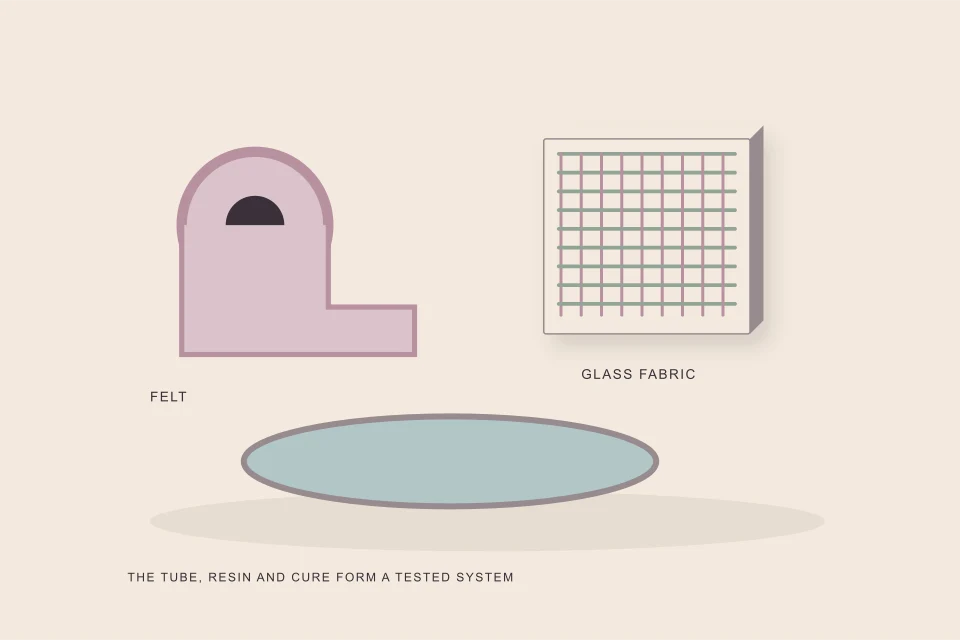
The appeal is control and speed: the reaction only runs where light falls, and the wet tube does not need to be kept on ice before installation. The limits follow from the physics. Light must reach through the whole wall, so glass fabric, which UV passes through, rather than thick felt is the standard reinforcement, and the lamp speed must suit the wall thickness. ASTM F1216 and F1743 now also include photo-initiated curing. NIOSH’s 2019 health hazard evaluation of an ultraviolet CIPP installer found styrene exposures that once exceeded the NIOSH short-term limit of 100 ppm, while grinding a cured pipe in an unventilated manhole, and recommended ventilating manholes throughout; UV does not by itself mean no styrene.
05 /What is an ambient cure?
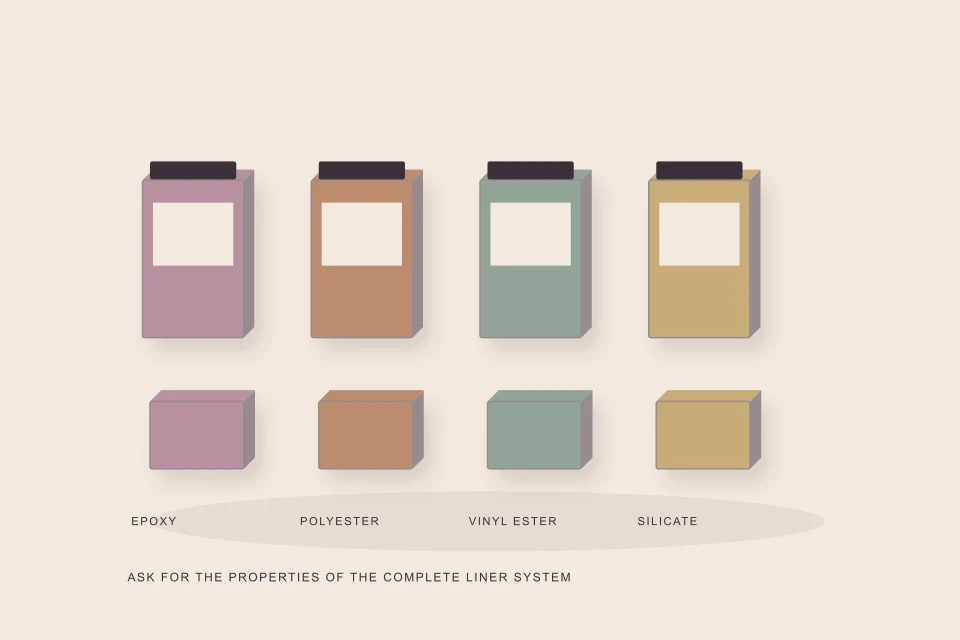
An ambient cure adds no heat. The resin, most often a two-part epoxy or a silicate system, is formulated to harden at the temperature of the pipe and surrounding ground, and the installer simply keeps the liner pressurised until it has. It needs no boiler, steam generator or lamp train, which makes it attractive for short liners, sectional repairs and single house laterals.
The price of that simplicity is time and temperature dependence. Cold pipe slows the reaction, so a Canadian winter job in a shallow line may cure more slowly than a summer one, and the installer must allow for it. Ask what cure time the system requires at the expected pipe temperature and how that temperature is checked. Some systems use a warm-water or steam boost to speed an otherwise ambient resin.
06 /Which cure suits which job?
| Cure | Heat or light source | Common pairing | What to watch |
|---|---|---|---|
| Hot water | Boiler; circulated water | Water inversion, felt tube | Even temperature along the length; controlled cool-down |
| Steam | Steam generator; condensate drained | Air inversion or pull-in, felt tube | Even temperature; condensate pooling; exhaust odour |
| UV light | Lamp train pulled through | Pull-in, glass-fibre tube (F2019) | Lamp speed against wall thickness; access for the train |
| Ambient | None; ground temperature | Epoxy or silicate; sectional and lateral work | Cure time at the real pipe temperature |
The EPA lists "must allow adequate curing time" and "curing can be difficult for long pipe segments" among the limitations of CIPP. Both apply to every method. The cure is never the place to save time; if a crew is in a hurry, the ends and the far end of the run are where under-cured resin is most likely.
07 /Does cold weather affect curing?
It can, and the effect depends on the method. Heat cures must bring the whole liner up to temperature, and cold ground and a cold host pipe draw heat away, so more energy and time go into the same result. Ambient cures slow in a cold pipe. UV cures are less affected by ground temperature, since the lamps drive the reaction, though equipment and resin handling still need care in the cold. SUDAS notes heat-cure tubes may be shipped refrigerated or packed in ice in warm weather; in winter the concern flips to keeping resin workable.
Lining is done year-round in Canadian cities. How municipalities handle it, and what local notices tell residents, is on the Across Canada page. For the steps before the cure, see wet-out and calibration and inversion vs pull-in-place.
08 /Can the cure be checked after the fact?
Partly. The cure record is the primary evidence, because it was written while the resin was reacting. After the fact, the final video can show soft, sagging or glossy areas, a trimmed end can be tested by touch for tackiness, and cured samples, cut at an access point or cured in a frame inside the pipe as the Iowa SUDAS manual describes, can be tested in a laboratory for flexural properties. On a house lateral the trimmed end at the cleanout is the easiest place to look and the one most homeowners can see for themselves.
09 /What should I ask about the cure?
- Which cure does this resin require, and which will you use?
- How is temperature or lamp speed monitored along the whole length, including the far end?
- How long will the line be out of use, and what is the cool-down step?
- Will I get the cure record with the final video?
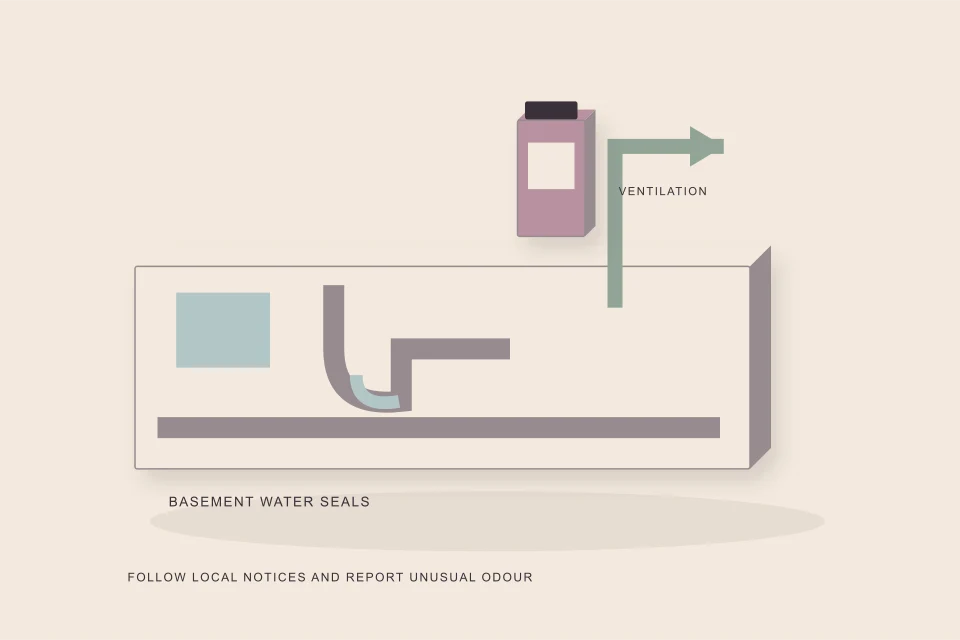
- What will the house smell like, and should traps be filled first?
Odour and what to do about it are covered in CIPP lining smell and styrene. The whole sequence is in how sewer relining works, and a quote can be checked by the HAUSE Sewer desk.
FAQQuestions people ask
Is UV-cured pipe lining better than steam-cured?
Not in every case. UV suits pulled-in glass-fibre liners and gives close control of the cure; steam and hot water suit felt liners and inversion. The system and the line decide.
Why is a CIPP liner cooled after curing?
A heat-cured liner is still soft while hot. Cooling it under pressure lets it set in shape against the pipe before the pressure is released.
How do I know my liner was fully cured?
From the cure record, temperatures and times or lamp speed and power, and from the final video, which should show no soft, sagging or tacky areas.
Can sewer lining be done in winter?
Yes. Cold ground slows heat and ambient cures, so the installer allows more time or energy. UV cures are less affected by ground temperature.
NETWORKGo deeper across the HAUSE Sewer network
Condo and apartment drain stack cleaning
Condo and apartment drain stack cleaning: why kitchen stacks back up on lower floors, how stacks are jetted or descaled, and how boards schedule it.
SewerJetting.caIs hydro jetting worth it? Benefits, how long it lasts and when it is an upsell
Is hydro jetting worth it? The real benefits, how long a jetted line stays clear by cause, why it costs more than snaking, and signs it is being oversold.
SewerQuotes.comTrenchless lining vs pipe bursting: cost, fit and trade-offs
Trenchless lining vs pipe bursting cost in Canada: 2026 CIPP and bursting ranges in CAD, line items, which defects each fixes and how to choose.
SOURCESSources and further reading
- ASTM F1216-22 (scope: hot water, steam or photo-initiated cure)
- ASTM F2019-20 (scope: GRP-CIPP, UV-light cure)
- Iowa SUDAS Design Manual, Section 14C-2
- NIOSH — Evaluation of Exposures to Styrene During Ultraviolet Cured-in-place Pipe Installation (HHE 2018-0009-3334, 2019)
- US EPA — Collection Systems O&M Fact Sheet: Trenchless Sewer Rehabilitation