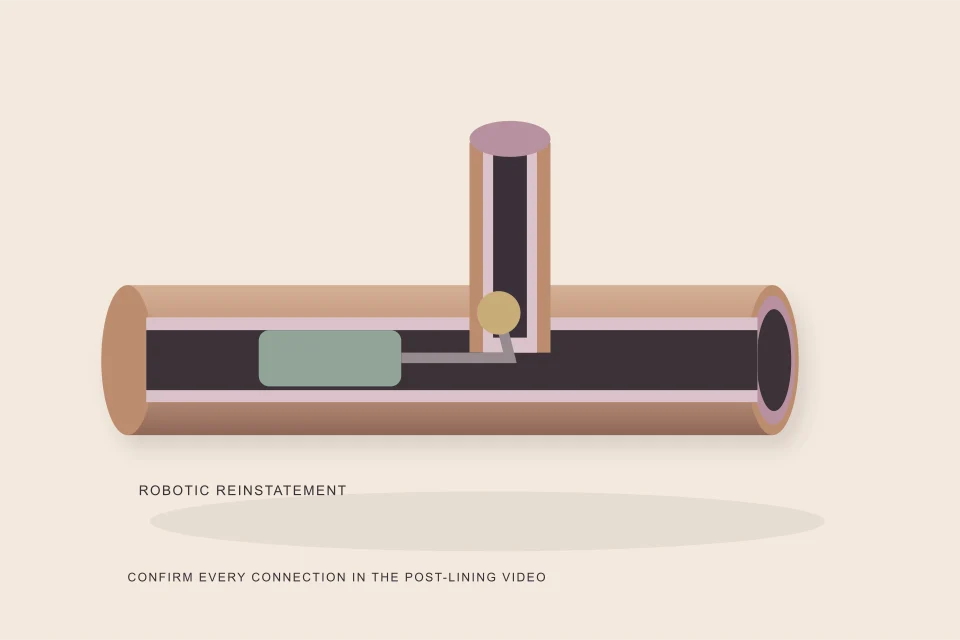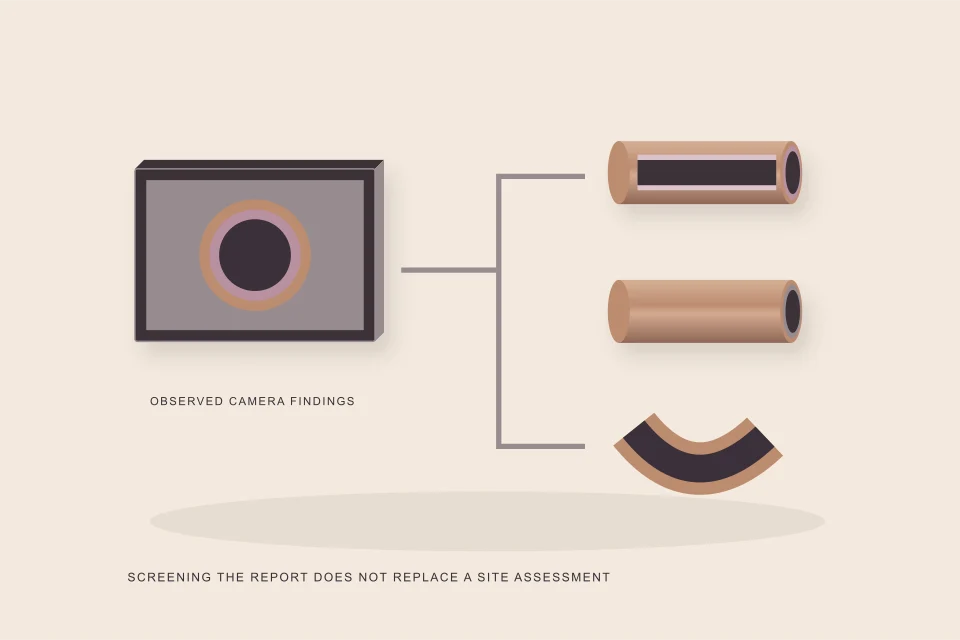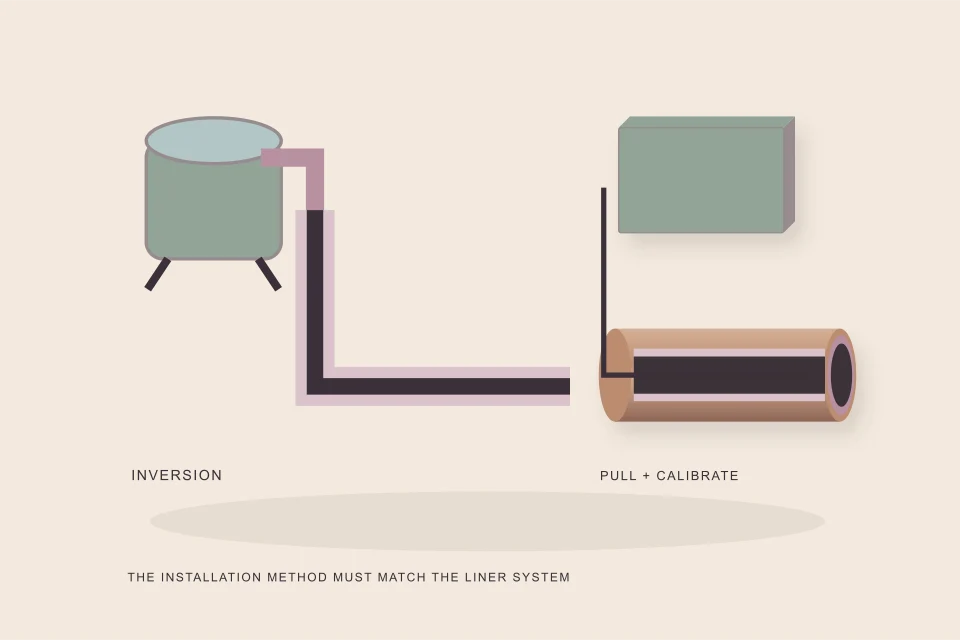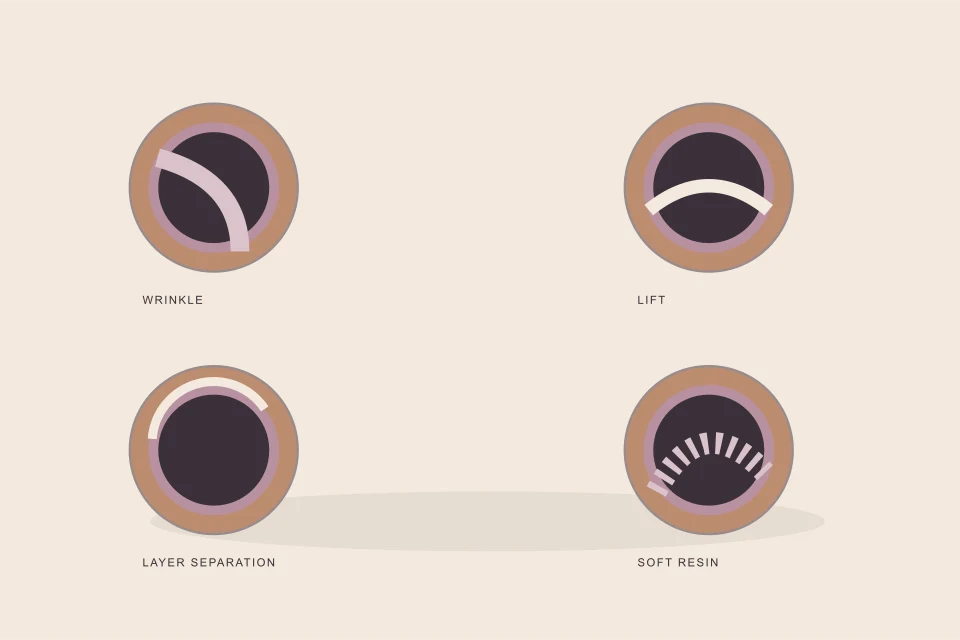
Most CIPP liner failures are built in on installation day. The common ones are wrinkles or fins at bends and size changes, lifts where water behind the liner pushes it inward, delamination of layers or the inner coating, soft or tacky resin that never fully cured, dry spots from poor wet-out, unsealed ends, and connections cut too small or too large. Each shows on a recorded final video.
- A final camera run of the whole liner, both ends and every connection, is the main quality check.
- Wrinkles and fins form where the tube had extra material: at bends, transitions and oversized sections.
- Lifts and unsealed ends are both about water getting into the annulus behind the liner.
- Soft, tacky or strong-smelling areas point to an incomplete cure.
- Many defects can be fixed from inside: grinding, recutting, a sectional liner or a connection seal.
01 /Why do CIPP liners fail?
Liners rarely fail because the material wears out. They fail because something in the preparation, wet-out, installation or cure did not go as designed, and the defect was cured into the wall. The US EPA lists the method’s inherent limits, the need to bypass flow, the need for adequate curing time, the difficulty of curing long segments, and a smaller diameter, and most practical failures trace to the second and third of those, or to cleaning that was not finished.
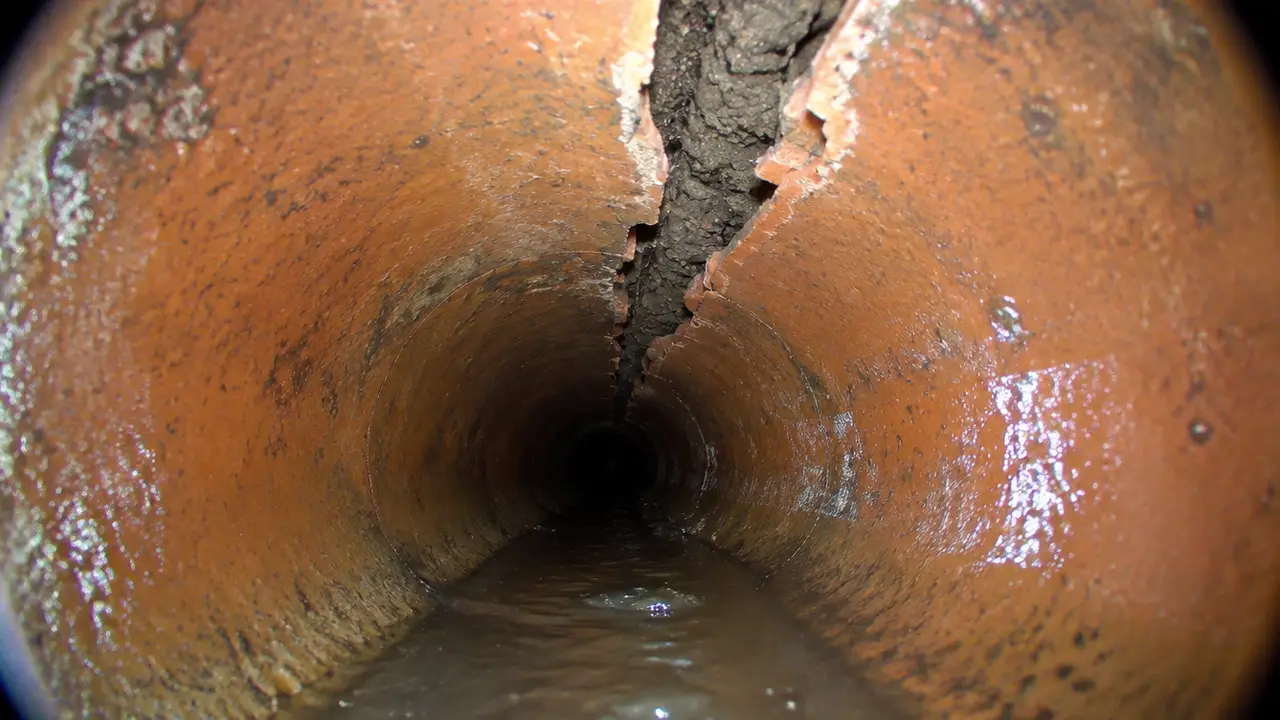
The good news is that almost every defect is visible. A cured liner is a smooth, continuous surface, so anything that is not smooth and continuous stands out on camera. That is why the final recorded video is the single most useful document from a lining job, and why homeowners should watch it, or have it read, before the job is closed.
02 /What causes wrinkles and fins in a liner?
Excess tube with nowhere to go. A liner is made to one diameter; where it passes through a bend, a diameter change, an oversized or oval section, or an offset joint, some of the tube must bunch up. Pressed against the wall and cured, the bunching becomes a wrinkle, a raised ridge across or along the pipe, or a fin, a fold that stands up into the flow.
Minor longitudinal wrinkles are common and often acceptable, especially on the sides of bends. Fins and transverse ridges that stand into the flow are a different matter: they catch paper, wipes and grease, and a fold can crack where the stress concentrates. Owners’ specifications often set limits on wrinkle height; ask the installer what they accept and whether any fin will be ground back. The Can My Sewer Be Relined? screen raises bends and transitions before lining for exactly this reason.
03 /What is a liner lift?
A lift is a section where the liner has moved inward, away from the host pipe, often seen as a smooth bulge on the invert or side. It usually means water, from groundwater, a leaking joint or a branch, got between the liner and the host pipe, either during the cure or later through an unsealed end or connection, and pushed on the liner from behind. It can also come from a loss of pressure during the cure, before the resin set.
A small, stable lift may be monitored. A lift that narrows the bore, grows between inspections, or sits where water is clearly tracking behind the liner is a sign that the annulus is open, and in a partially deteriorated design it means the liner is carrying pressure it may not have been designed for. The design side of groundwater pressure is in liner thickness and ASTM F1216.
04 /What is delamination?
Delamination is separation within the liner wall: layers of the tube coming apart, or the inner coating or membrane separating from the cured felt. On camera it can look like a blister, a loose skin or a flap. The Iowa SUDAS manual lists delamination testing among the checks done on cured samples, alongside flexural properties, which shows it is a recognised failure mode rather than a curiosity.
Causes include moisture or contamination in the tube before the cure, an incomplete bond between resin and coating, and cure temperatures that were not reached through the full wall thickness. A loose inner skin can catch solids even if the structural wall behind it is sound; a separation within the structural layers weakens the wall.
05 /How do I recognise soft or uncured resin?
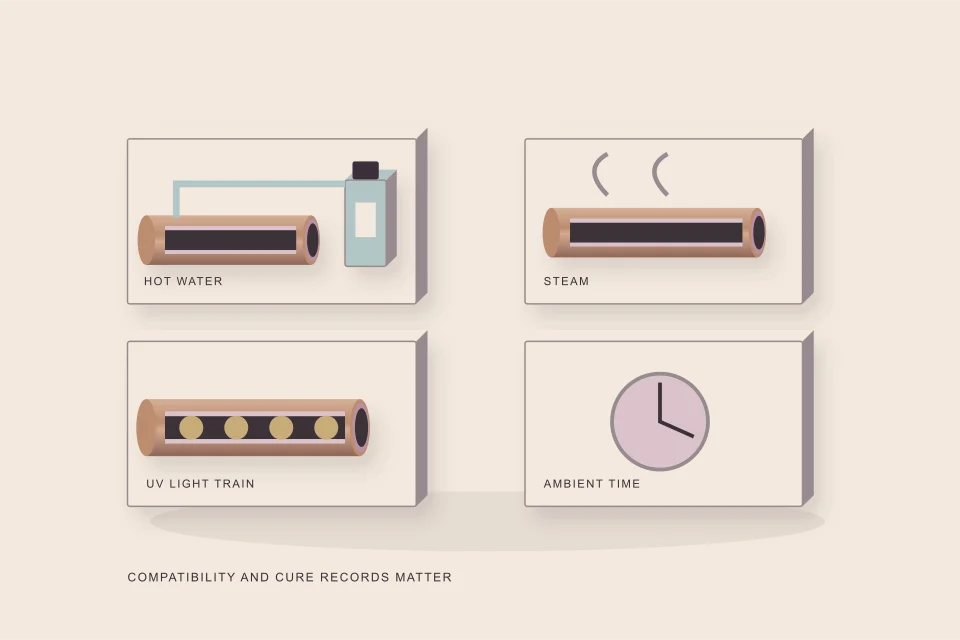
Uncured or under-cured resin is the most serious defect because it affects the liner’s strength directly. It happens when part of the liner never reached the conditions the resin needs: a cold spot in a heat cure, often at the far end or where groundwater drew heat away, a lamp train run too fast in a UV cure, or an ambient cure given too little time in a cold pipe. Resin mixed in the wrong proportions can also fail to harden.
- On video: a sagging or deformed area, a glossy wet look, or a section that deflects when the camera or a tool touches it.
- At the ends: a trimmed end that is tacky or can be dented with a fingernail.
- By smell: a strong resin odour inside the house that persists well after the job, which should be reported to the installer.
The cure record, temperatures and times or lamp speed and power, is the evidence that the whole liner was cured. Ask for it. CIPP curing methods explains what each record should show.
06 /What are dry spots, unsealed ends and bad cuts?
| Defect | Usual cause | Usual fix |
|---|---|---|
| Dry spot | Trapped air or a starved section at wet-out | Sectional liner over the area |
| Unsealed end | No end seal, or a seal that failed | End seal or a short sectional liner at the transition |
| Under-cut connection | Cutter stopped short of the branch wall | Recut and brush |
| Over-cut connection | Cutter ran past the branch wall | Connection seal or patch |
| Missed connection | Not recorded before lining, or not found | Locate and cut; check that fixtures drain |
| Liner too short | Measurement or stretch error | Sectional liner to close the gap |
| Resin slugs or ridges | Excess resin pooled before the cure | Grind flush |
Connection cuts are illustrated in reinstating connections after lining, and wet-out problems in wet-out and calibration.
07 /How are liner defects prevented in the first place?
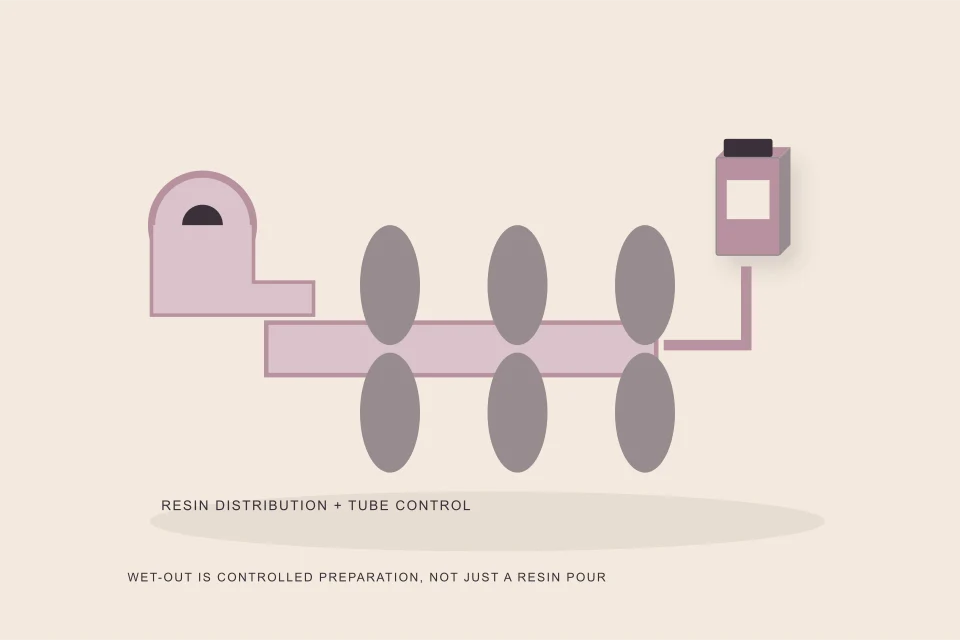
Almost every defect in this guide has a step earlier in the job that prevents it. Wrinkles are prevented by choosing a tube and method suited to the bends and transitions the camera showed. Lifts and unsealed ends are prevented by end seals, connection seals and holding pressure through the cure. Dry spots are prevented at wet-out, with vacuum, a measured resin charge and calibration rollers. Soft resin is prevented by following the resin system’s cure requirements and recording them. Missed or badly cut connections are prevented by recording every branch by distance before lining and filming each one after. When you read a quote, look for each of those steps; a quote that names them is describing a process that tends to avoid these defects.
08 /What should I do if my liner has a defect?
Start with the video and the paperwork. Note the distance to each defect, take screenshots, and compare with the pre-lining and post-cleaning videos to see whether it is new. Then raise it with the installer in writing, while the job is fresh and before any holdback is released. Most defects can be fixed from inside: fins ground back, connections recut, a sectional liner installed over a dry spot or a lift, an end sealed.
- Get the final video as a file, with distances.
- List each defect by distance and type.
- Ask the installer which are within their acceptance criteria and which they will fix, and how.
- Ask for a new video after any repair.
- Keep everything with the house records.
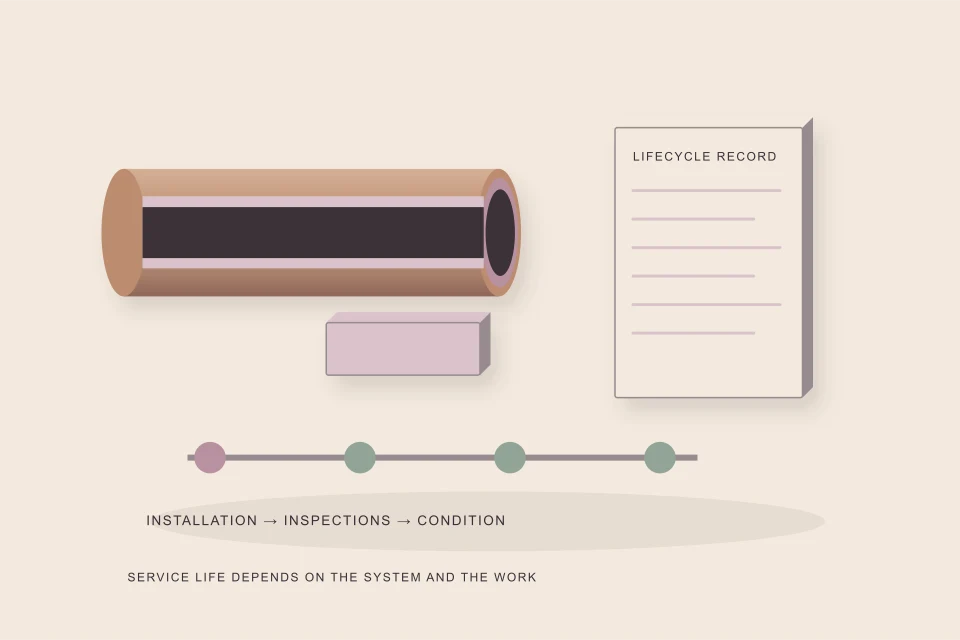
An independent reading of the video can help when you and the installer disagree. Send it to the HAUSE Sewer desk for a second look. Whether the line needs more than a fix is a repair decision covered on sister site TrenchlessSewerRepair.ca, and the effect of defects on lifespan is in how long sewer relining lasts.
FAQQuestions people ask
Is a wrinkle in a sewer liner a problem?
Small longitudinal wrinkles at bends are common and often acceptable. Fins or ridges that stand into the flow can catch solids and should be discussed with the installer.
What causes a sewer liner to bulge inward?
Usually water trapped between the liner and the old pipe, from groundwater, a leaking joint or an unsealed end, or a loss of pressure during the cure.
Can a failed section of liner be repaired without relining everything?
Often, yes. Grinding, recutting, a connection seal or a short sectional liner can fix a local defect from inside.
What does a soft spot in a CIPP liner mean?
Resin that did not fully cure. It is weaker than designed and should be investigated with the cure record.
NETWORKGo deeper across the HAUSE Sewer network
Jetting before trenchless lining: why the prep cleaning decides the result
Why jetting before trenchless lining matters: root removal, descaling cast iron, cleaning to a bare wall, camera checks and what rushed CIPP prep causes.
SewerRoots.caSewer lining for tree roots: will a CIPP liner stop them for good?
Sewer lining for tree roots: how a CIPP liner seals root-damaged joints, which lines qualify, preparation, weak points at the ends, and planning costs.
SewerQuotes.comSewer pipe lining cost: what a CIPP liner should cost in Canada
Sewer pipe lining cost in Canada (2026): CIPP liner ranges in CAD for full laterals and single sections, the line items, cost drivers and quality checks.