The Liner Thickness Explorer runs the published ASTM F1216 appendix design equations, as set out in the Iowa SUDAS design manual, for a pipe size, depth, groundwater level, ovality and resin stiffness you choose. It shows the minimum wall each design check requires, which check governs, the dimension ratio and the bore left after lining. It teaches what drives thickness; it is not a liner design.
- Partially deteriorated pipe is designed against groundwater buckling; with no groundwater the liner is held to a dimension ratio of 100 or less.
- Fully deteriorated pipe is designed for water, soil and traffic together, plus a minimum-stiffness check.
- Ovality is punishing: at 5% out of round the buckling capacity is multiplied by 0.64, and a bending check can add thickness.
- The two worked examples from the SUDAS manual reproduce here: 0.226 in (5.7 mm) and 0.199 to 0.200 in (5.1 mm) for a 12 in sewer.
Liner Thickness Explorer
01 /What does the Liner Thickness Explorer calculate?
It calculates the minimum structural wall a cured-in-place liner needs under the design approach in the non-mandatory appendix of ASTM F1216, the standard practice for inverted liners. Those equations are widely reproduced in municipal and state design guidance. The version used here is the Iowa Statewide Urban Design and Specifications (SUDAS) Design Manual, Section 14C-2, which rearranges each appendix equation to solve directly for thickness and publishes two worked examples. Every formula, default and label in the tool comes from that section.
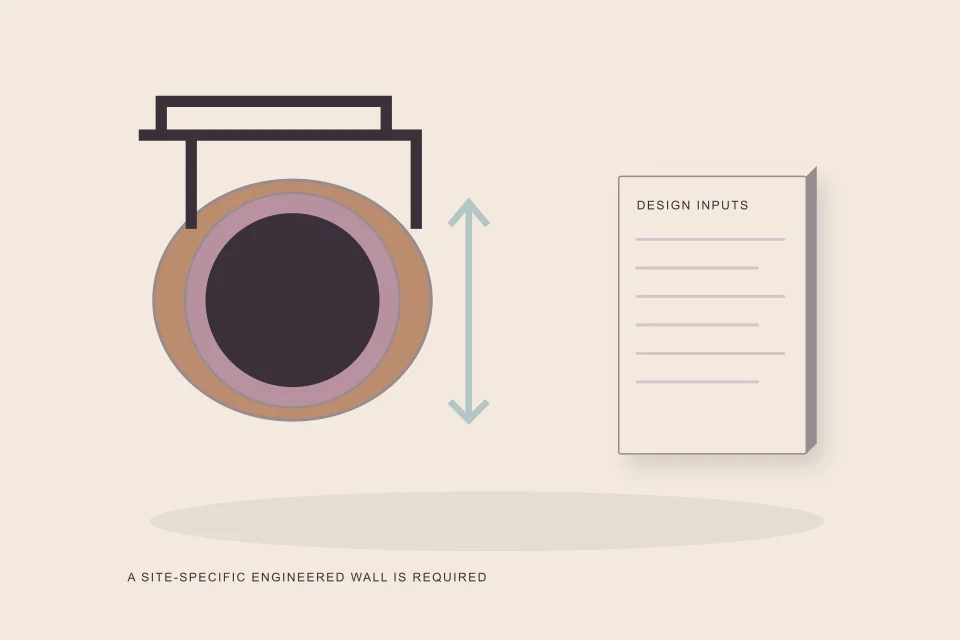
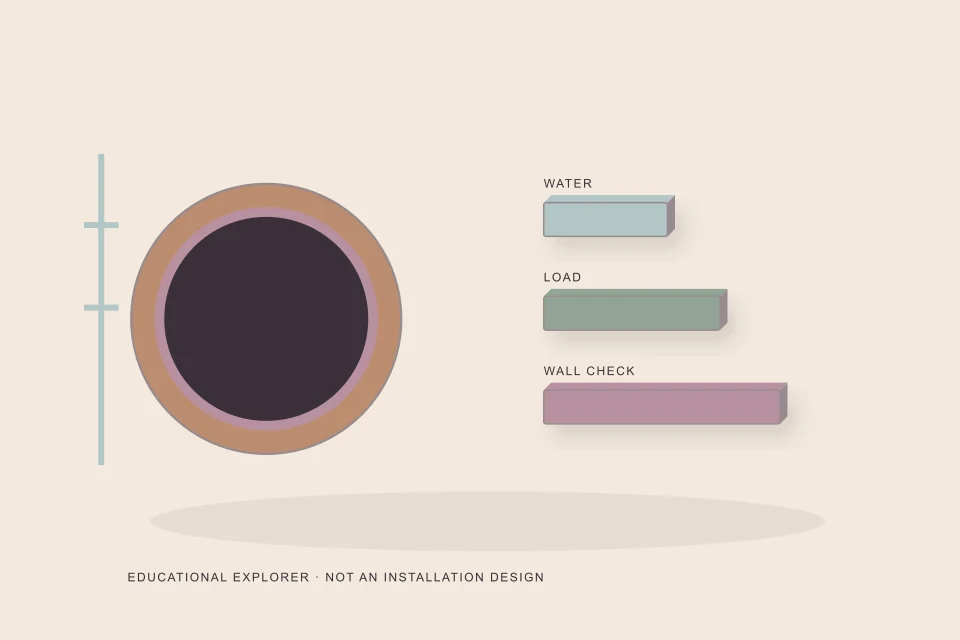
Enter a liner diameter, the soil depth over the pipe, the groundwater level, the ovality seen on camera and the resin stiffness, and the tool returns the thickness each design check requires, the governing check, the dimension ratio (diameter divided by thickness) and the share of the original flow area left inside the liner. A ring drawn to scale shows how thin or thick that wall is against the pipe.
02 /What do the inputs mean?
| Input | Default | Role |
|---|---|---|
| Host pipe condition | Partially deteriorated | Chooses which set of checks runs |
| Liner outside diameter (mm) | 100 | D in every equation; close to the host pipe’s inside diameter |
| Soil over the top of the pipe (m) | 2.0 | Soil load, buoyancy and elastic support (fully deteriorated) |
| Groundwater above the top of the pipe (m) | 1.0 | External water pressure, 0.433 psi per foot of head |
| Ovality (%) | 2 | Ovality reduction factor C and the bending check |
| Short-term flexural modulus | 300,000 psi (2,068 MPa) | Halved to a long-term modulus; the minimum-stiffness check uses it directly |
| Long-term flexural strength (MPa) | 17.2 (2,500 psi) | Limit for the bending check |
| Soil unit weight (kg/m³) | 1,920 | Soil prism load (fully deteriorated) |
| Modulus of soil reaction | 1,000 psi (6.9 MPa) | Support from the ground (fully deteriorated) |
| Traffic over the pipe | None | Adds the HS-20 highway live load from the SUDAS table (fully deteriorated) |
The three modulus choices are the values SUDAS lists as common for CIPP resins: 250,000, 300,000 and 400,000 psi. SUDAS applies a reduction, normally 50%, to allow for creep over the liner’s life, and the tool does the same. The default long-term flexural strength of 2,500 psi is the value used in the SUDAS worked examples; replace it with the manufacturer’s figure when you have one. The soil modulus range of 500 to 2,000 psi is the one SUDAS suggests, from badly broken host pipe to fair pipe.
03 /Which equations run for a partially deteriorated pipe?
In the partially deteriorated condition the old pipe still carries the soil, so the liner is designed to resist the external pressure of groundwater without buckling. SUDAS Equation 14C-2.01 rearranges ASTM F1216 Equation X1.1 to give the thickness directly.
| Check | Formula | Terms |
|---|---|---|
| Groundwater buckling (X1.1) | t = D ÷ [ (2 K Eₗ C ÷ (Pᵂ (1 − ν²) N))^⅓ + 1 ] | K = 7, N = 2, ν = 0.3, Eₗ = 50% of E, Pᵂ = 0.433 × head in feet (psi) |
| Ovality factor | C = [ (1 − q/100) ÷ (1 + q/100)² ]³ | q = percent ovality |
| No groundwater | t = D ÷ 100 | ASTM F1216 recommends a maximum DR of 100 |
| Ovality bending | 1.5 (q/100)(1 + q/100)(D/t)² − 0.5 (1 + q/100)(D/t), times Pᵂ N, must not exceed the long-term flexural strength | Only when the pipe is oval and under water |
K is the enhancement factor for the support the soil and old pipe give the liner; SUDAS gives 7 as typical and conservative. N is the factor of safety, normally 2.0. When the bending stress at the buckling thickness would exceed the strength entered, the tool increases the thickness step by step until it passes, and names the bending check as governing. Above 10% ovality the partially deteriorated definition no longer applies, and the tool says so.
04 /Which equations run for a fully deteriorated pipe?
In the fully deteriorated condition the liner is designed as if the old pipe were not there. SUDAS first totals the external load, then solves a rearranged ASTM F1216 Equation X1.3 for thickness, then applies a minimum-stiffness check.
- Water buoyancy factor: Rᵂ = 1 − 0.33 × (water height ÷ soil height), never below 0.67.
- Soil prism load: Pₛ = unit weight (lb/ft³) × soil height (ft) × Rᵂ ÷ 144, in psi.
- Traffic: the SUDAS HS-20 highway values of 16, 7, 3, 2 and 2 psi at 1, 2, 3, 4 and 5 ft of cover. The tool uses the value for the listed depth at or just above yours, and adds none below 5 ft, where the table stops, with a note.
- Elastic support: B′ = 1 ÷ (1 + 4e^(−0.065 H)), with H the soil height in feet.
- All loads (X1.3): t = [ 0.375 (N Pₜ ÷ C)² D³ ÷ (Eₗ Rᵂ B′ E′ₛ) ]^⅓, where Pₜ is water plus soil plus traffic.
- Minimum stiffness (X1.4): t = D × (1.116 ÷ E)^⅓, using the short-term modulus, a pipe-stiffness floor for handling and installation.
The same ovality bending check runs afterwards when the pipe is oval and below the water table. The governing thickness is the largest the checks require.
05 /Do the results match the published examples?
Yes. The two buttons at the top of the tool load the SUDAS worked examples, converted to metric, and the tool reproduces their answers. Small differences in the last digit come from SUDAS rounding intermediate values.
| Example | Inputs | SUDAS | Tool |
|---|---|---|---|
| Partially deteriorated 12 in sewer | 304.8 mm; top of pipe 4.57 m deep; water 3.66 m above it; 5% oval; E 300,000 psi | 0.226 in; bending 2,020 psi | 5.7 mm (0.226 in); bending 14.0 MPa (about 2,025 psi) |
| Fully deteriorated 12 in clay sewer under a street | 304.8 mm; 1.52 m of cover; water 0.61 m above the pipe; 120 lb/ft³ soil; HS-20; E′ₛ 1,000 psi; 5% oval | 0.199 in; minimum 0.186 in | 5.1 mm (0.200 in); minimum 4.7 mm (0.186 in) |
At the default settings, a 100 mm lateral 2 m deep with 1 m of groundwater above it and 2% ovality, the buckling check needs about 1.1 mm, a dimension ratio near 89, and the bending stress is about 3.9 MPa against 17.2 MPa. Switch the same pipe to fully deteriorated and the minimum-stiffness check governs at about 1.5 mm.
06 /Why is a real liner usually thicker than the result?
For small residential laterals the calculated minimum is often very thin, because a 100 mm pipe has little surface for water pressure to act on. Real liners are made from tubes in set thicknesses, so the installed wall is chosen from what the manufacturer makes and is often thicker than the calculation. Design criteria also vary: an owner may require a fully deteriorated design everywhere, a higher safety factor, or tested long-term properties in place of the typical 50% reduction.
Three inputs move the answer most. Groundwater head drives the partially deteriorated result. Ovality multiplies it through C, which falls from 1.00 for a round pipe to 0.64 at 5% and 0.41 at 10%. And in the fully deteriorated case the soil modulus and depth move it through the support terms. The reasons behind each are set out in liner thickness and ASTM F1216, and the way the tube itself is built is in CIPP liner tubes.
07 /How should I use this with a quote?
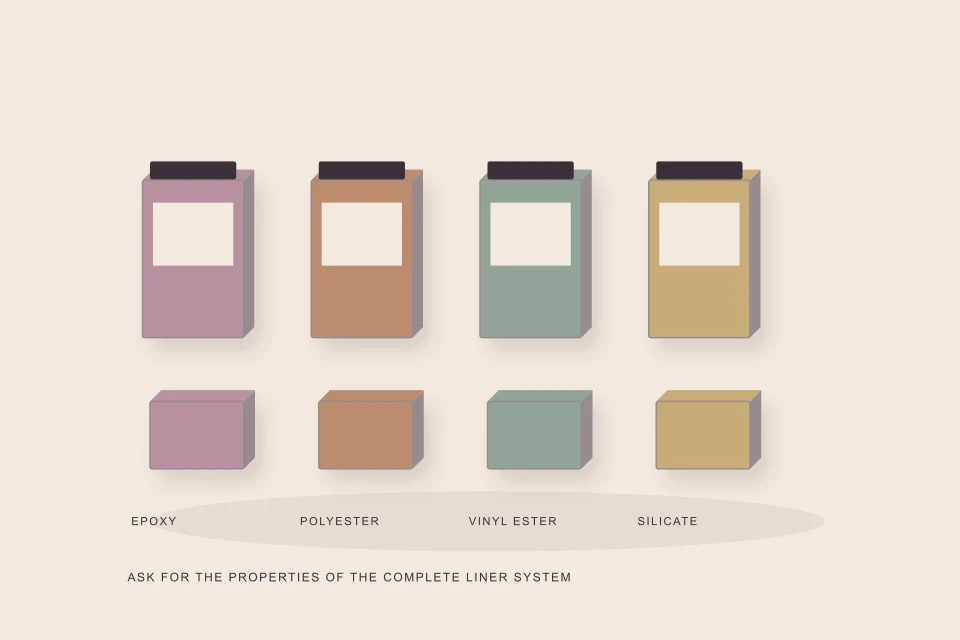
Ask each installer which design condition they designed for, which modulus and long-term strength they used and where those numbers come from, the groundwater level and ovality they assumed, and the thickness that resulted. Enter those values here. If your result is thinner than theirs, the difference is usually tube availability or a stricter criterion; if it is thicker, ask why.
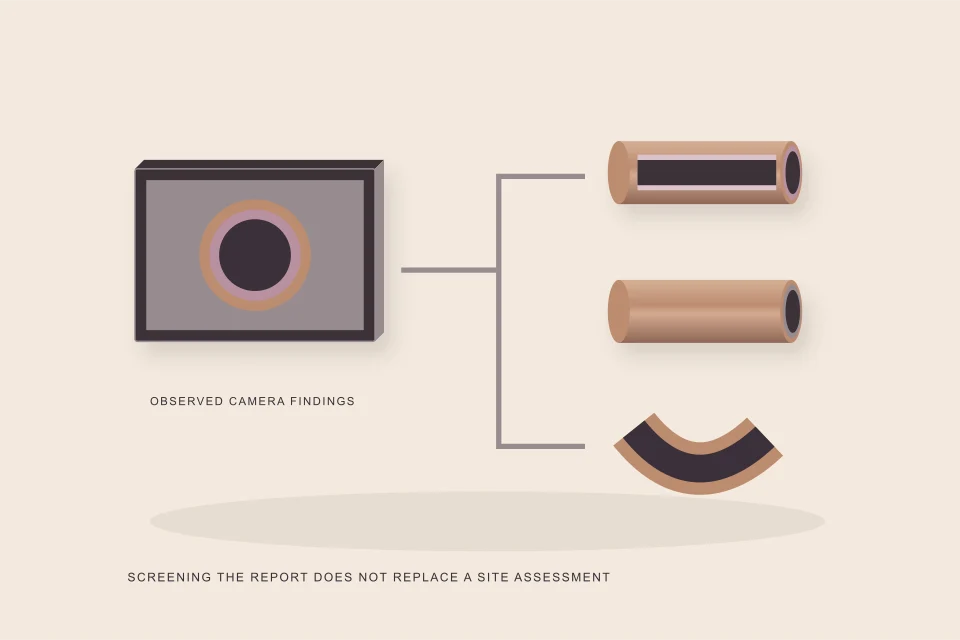
- Screen the line first with Can My Sewer Be Relined? to see which condition your camera findings point to.
- Enter the diameter, depth and the highest groundwater level you know of; a seasonal high matters more than a dry-day reading.
- Read ovality from the worst spot on the video, as SUDAS advises.
- Compare the governing check with the quote, and ask how the liner’s cured thickness will be checked after installation.
Cost follows length, diameter and system more than a millimetre of wall; the ranges are on the sewer relining cost page. For a second opinion on a lining quote, send it to the HAUSE Sewer desk.
FAQQuestions people ask
How thick is a CIPP liner in a house sewer?
It depends on the design. The published equations often give a millimetre or two for a 100 mm lateral, but installed liners come from set tube thicknesses and are commonly thicker. Ask for the designed and installed thickness.
What is the enhancement factor K in liner design?
It accounts for the support the old pipe and soil give the liner against buckling. SUDAS lists 7 as the typical, conservative value.
Why does ovality make a liner thicker?
An oval liner buckles more easily and bends under pressure. The ovality factor cuts its capacity to 0.64 of a round pipe at 5% ovality, and a bending check may add more.
What is a dimension ratio (DR) for a liner?
The liner outside diameter divided by its wall thickness. A lower DR means a thicker, stiffer wall; ASTM F1216 recommends no more than 100 where there is no groundwater.
Can I use this tool to design my liner?
No. It shows how the published equations behave. The installer’s design, built on the manufacturer’s tested values and your site, is the one that counts.
NETWORKGo deeper across the HAUSE Sewer network
Sewer Maintenance Planner
Sewer Maintenance Planner: a suggested cleaning and camera inspection interval plus a 12-month checklist based on your house, pipes, trees and history.
SewerQuotes.comSewer line replacement cost by city: why local quotes differ
Sewer line replacement cost by city: why Calgary, Edmonton, Regina and other Canadian markets quote differently, GST/HST by province, and local drivers.
SewerRoots.caSewer lining for tree roots: will a CIPP liner stop them for good?
Sewer lining for tree roots: how a CIPP liner seals root-damaged joints, which lines qualify, preparation, weak points at the ends, and planning costs.