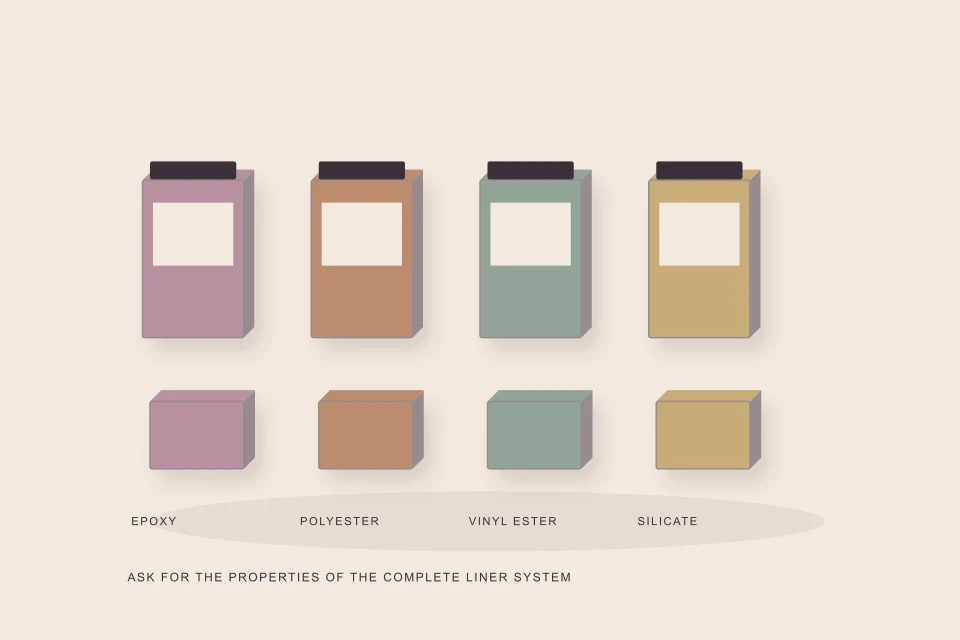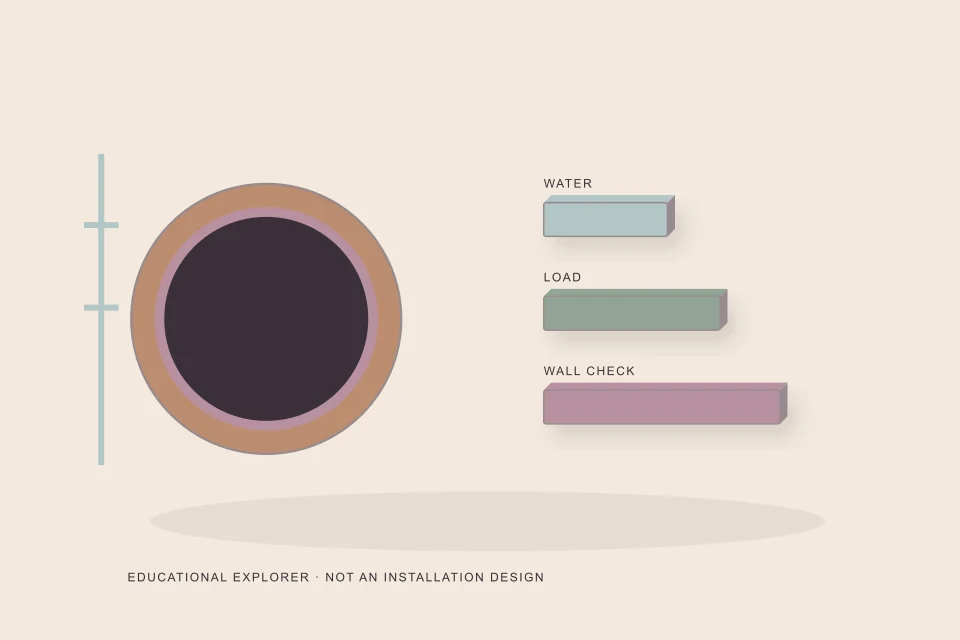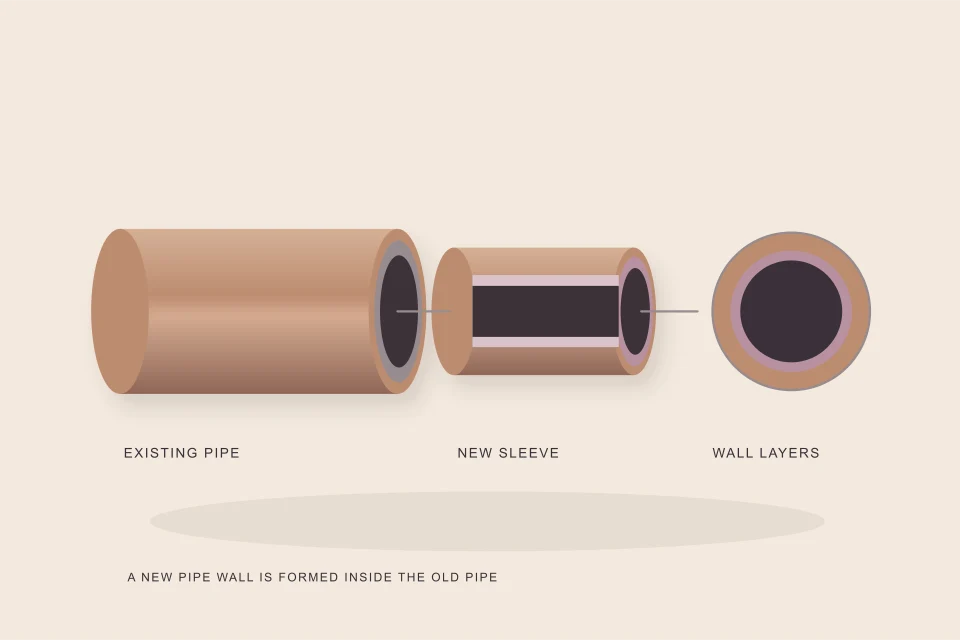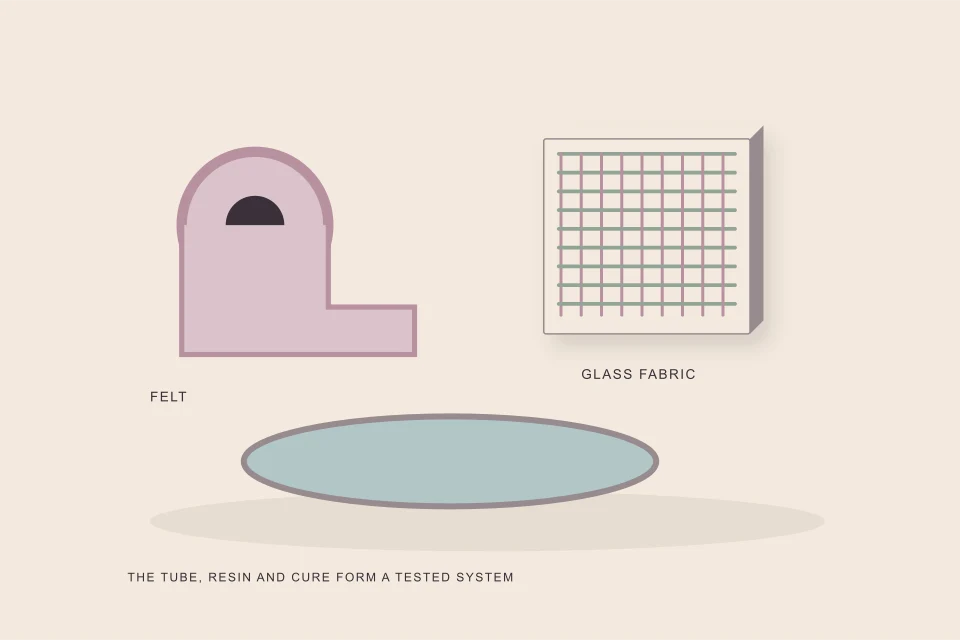
The tube is the reinforcement of a cured-in-place liner. Most are absorbent felt with a plastic membrane on one face, the type the Iowa SUDAS manual describes; the other main family is glass-fibre fabric, named in the UV-cure practice ASTM F2019. The tube carries the resin, sets the wall thickness, and decides which installation and cure methods fit. Bladders and calibration hoses press it into place, then come out.
- A felt tube soaks up resin like a sponge and is made to the length and diameter of each job.
- Glass-fibre tubes are stiffer, carry a photo-initiated resin, and are pulled in and cured with UV light under ASTM F2019.
- The membrane keeps resin in the tube; after inversion it is the liner’s inside face, after pull-in it stays outside.
- Preliners, calibration hoses and bladders are installation aids; most are removed after the cure.
- Tube thickness is chosen to meet the calculated design thickness, from the sizes a manufacturer makes.
01 /What does the tube do in a CIPP liner?
The tube does three jobs. It carries the resin into the pipe, holding it in place until it hardens. It sets the geometry of the finished liner, its length, diameter and wall thickness. And once cured it becomes the reinforcement inside the plastic, the fibre network that gives a composite wall its strength, much as steel does in concrete. Resin on its own would run to the bottom of the pipe; tube on its own is a soft sock. Together, cured under pressure, they are a pipe.
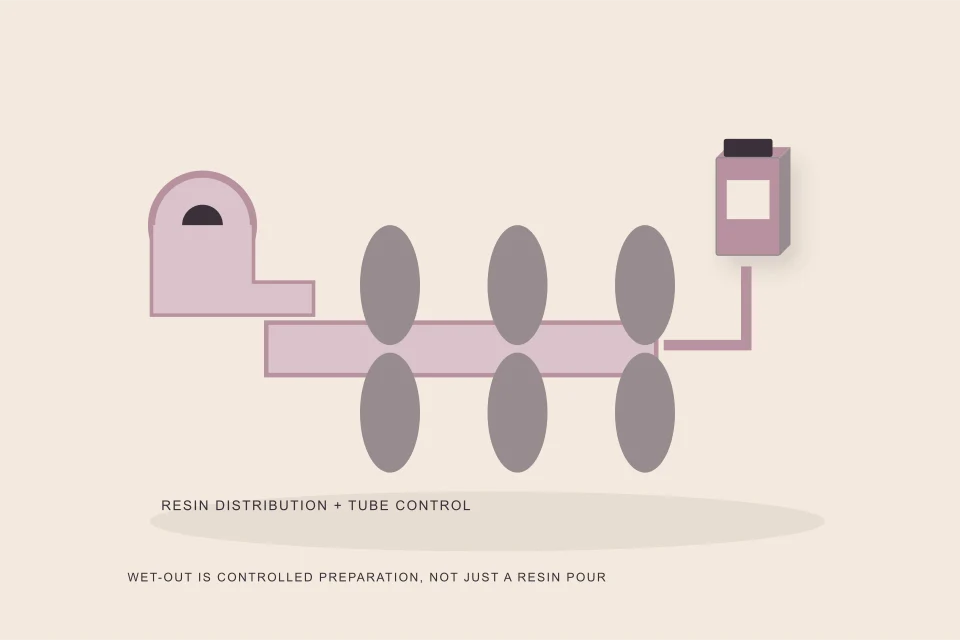
That makes the tube the part of the system most tied to the job. SUDAS notes that the size and length of the tube are custom-made for each project, which is also why the method suits odd sizes and shapes, such as old brick sewers. For a homeowner it means the camera measurements are not a formality: the tube is cut, and often wet out, to those numbers before it arrives.
02 /What are felt liner tubes?
Felt is the original and still the most common tube. It is a non-woven fabric, polyester felt being typical, built up to the thickness the design calls for. Its value is absorbency: the open felt structure takes up a large volume of resin and holds it evenly, and it stretches enough to follow the host pipe closely, press into small irregularities and cope with modest bends. The SUDAS manual describes it as an absorbent, flexible, industrial-grade felt tube with an impermeable membrane on the inside surface.
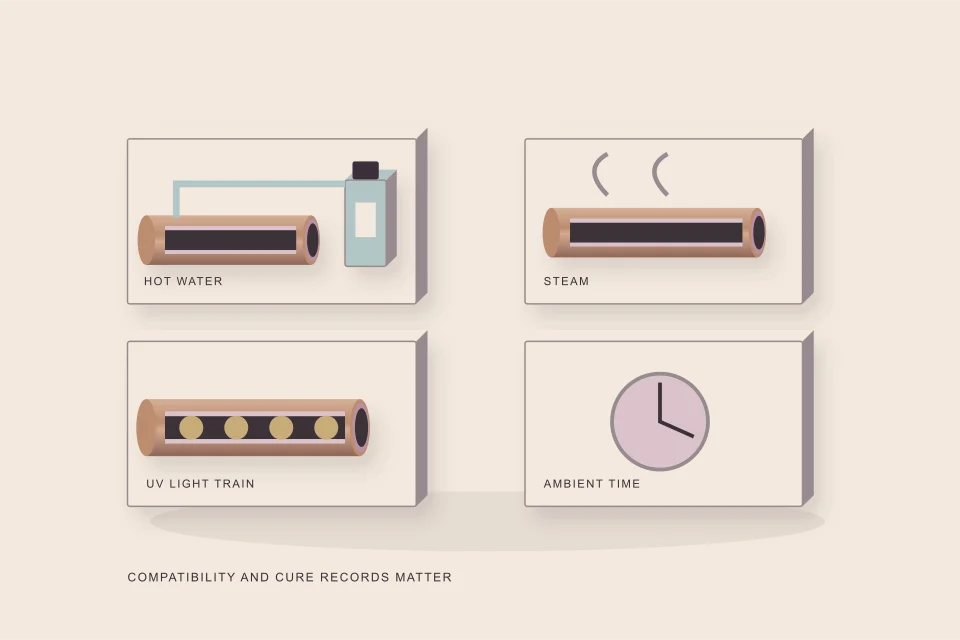
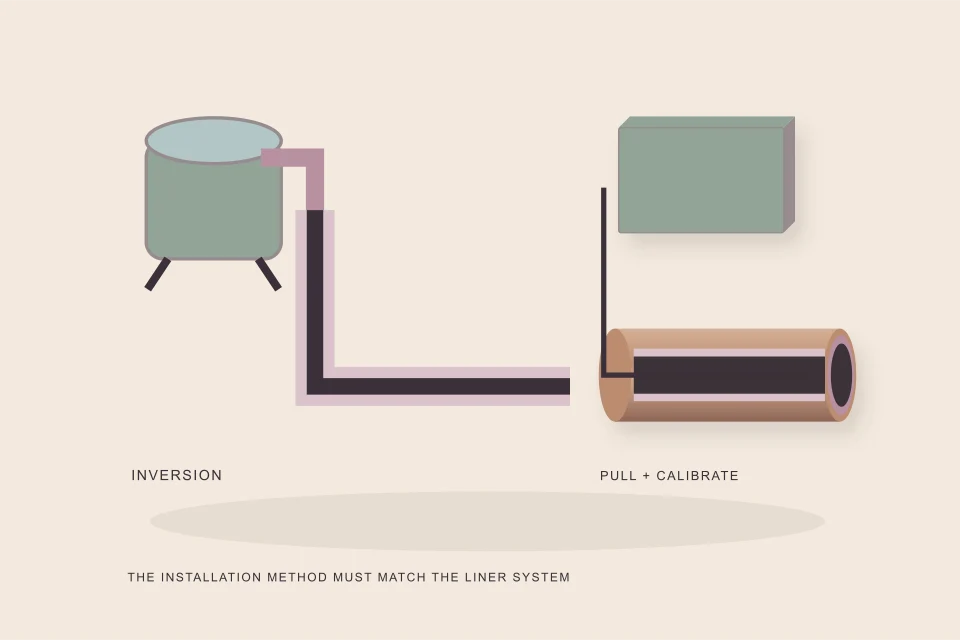
Felt tubes suit inversion, because a flexible, resin-filled sock turns inside out readily under a column of water or air pressure. They are equally used in pull-in-place installations. Felt is cured by heat in most systems, circulated hot water or steam, and by ambient-cure resins in some small-diameter lateral systems. Because the resin does most of the structural work in a felt liner, the resin’s stiffness, the flexural modulus used in the design, is what the thickness calculation leans on.
| Property | Felt tube | Glass-fibre tube |
|---|---|---|
| Structure | Non-woven felt, absorbent | Woven or stitched glass fabric |
| Named in | F1216, F1743 and the SUDAS description | F2019 (pulled in, UV-cured) |
| Usual installation | Inversion or pull-in-place | Pull-in-place, inflated with air |
| Usual cure | Hot water, steam, some ambient | UV light with a photo-initiated resin |
| What to ask | Felt thickness and resin volume per metre | Laminate build-up and lamp speed record |
03 /What are glass-fibre liner tubes?
Glass-fibre tubes replace felt with layers of glass fabric. ASTM F2019 covers them for pipes from 4 to 72 inches (100 to 1830 mm): a glass-reinforced tube impregnated with a photo-initiated resin is pulled into the host pipe, inflated with compressed air to press it against the wall, and cured with ultraviolet light. Glass is translucent to UV in a way that thick felt is not, which is what makes a lamp train practical.
Glass reinforcement is stiffer than felt, so for the same design load a glass-reinforced wall can often be thinner, which leaves more bore. The trade-off is handling: under F2019 a glass tube is pulled in rather than inverted, so installers weigh the host pipe’s bends, access and any diameter change before choosing it. As with any system, the design uses the manufacturer’s tested properties rather than general claims; ask for them.
04 /What is the membrane or coating for?
Every tube carries a thin, impermeable plastic layer on one face. Before installation it keeps resin in and water out and lets the tube be vacuum-impregnated. After installation its position depends on the method, and it is a good way to see what a quote really describes.
- Inversion: SUDAS explains that the felt tube is made with the membrane on its inside surface and turned inside out as the resin is applied, so the membrane is on the outside during delivery. Inverting it into the pipe turns it back again: the resin-soaked felt is pressed onto the host wall and the membrane becomes the liner’s smooth inside face.
- Pull-in-place: the membrane stays on the outside of the tube for the whole process. SUDAS notes it may be left impermeable or perforated or slotted before installation, which should be specified, and that even perforated, it can inhibit resin migration into joints and cracks.
Why that matters: an inverted liner squeezes a little resin into open joints and cracks, helping seal leaks, which is why F1216 calls for 5 to 10% extra resin. A pulled-in tube with an outer membrane does less of that. Neither is wrong; they suit different lines, as inversion vs pull-in-place explains.
05 /What are preliners, calibration hoses and bladders?
Several tubes that are not part of the finished liner do essential work during installation. Quotes and videos mention them, and search terms such as "pipe relining bladder" and "sewer line bladder" usually refer to one of them.
| Item | What it does | After the cure |
|---|---|---|
| Preliner | A thin film pulled in first to keep groundwater and debris off the resin and resin out of large voids | Stays in place outside the liner |
| Calibration hose | An inner hose inverted or inflated inside a pulled-in tube to press it outward | Removed, or in some systems left as the inner surface |
| Bladder | An inflatable sleeve, usually for sectional repairs and short laterals, holding a short tube against the wall | Deflated and withdrawn |
| Inversion drum or vessel | Holds the wet tube and supplies air pressure to invert it from a cleanout | Removed with the equipment |
The sectional repair practice, ASTM F2599, describes a short tube inverted and inflated against a damaged section and held there by air or water pressure until the resin cures. On a house lateral that usually means a packer carrying a short felt tube to one defect; the repair-scale choice between that and a full liner is covered on sister site TrenchlessSewerRepair.ca.
06 /How does tube thickness relate to the design?
The design calculation gives a minimum structural wall. The installer then picks a tube whose cured wall meets or exceeds it, from the thicknesses the manufacturer makes. For small laterals the published equations often return a very thin minimum, so the tube chosen is commonly thicker than the calculation; the Liner Thickness Explorer shows the minimums for your inputs, and liner thickness and ASTM F1216 explains the checks behind them.
A felt tube can also thin slightly where it stretches, at bends or where the host pipe is a little larger than nominal, and thicken where it bunches. That is one reason specifications ask for cured samples or measurements after installation. SUDAS describes two ways samples are made: cut from the liner where it passes through an intermediate access point or at its end, or cured in a frame placed inside the pipe during the cure, then tested for flexural properties and delamination.
07 /What should I ask about the tube?
- Is the tube felt or glass fibre, and which ASTM practice does the installation follow?
- What cured thickness will it be, and what design thickness did the calculation give?
- Is it rated for the bends and any diameter change on my line?
- Where does the membrane end up, inside or outside, and is a preliner used?
- Will a sample or measurement of the cured wall be taken?
Put those alongside the resin questions in CIPP resins and the cure questions in CIPP curing methods, and you have the full description of the product being quoted. To have a quote checked against them, send it to the HAUSE Sewer desk.
FAQQuestions people ask
What material is a sewer liner tube made of?
Usually felt, often polyester felt, with a plastic membrane on one face. Glass-fibre fabric tubes are the other main type and are used for UV-cured liners.
What is a pipe relining bladder?
An inflatable sleeve used during installation, most often for sectional repairs, to hold a short resin tube against the wall until it cures. It is removed afterwards.
Are glass-fibre liners stronger than felt liners?
Glass reinforcement is stiffer, so a thinner wall can meet the same design load. The design always uses the specific system’s tested values, not a general rule.
Is the tube made to measure for each sewer?
Yes. Length and diameter come from the camera measurements, and the thickness from the design calculation.
NETWORKGo deeper across the HAUSE Sewer network
Jetting before trenchless lining: why the prep cleaning decides the result
Why jetting before trenchless lining matters: root removal, descaling cast iron, cleaning to a bare wall, camera checks and what rushed CIPP prep causes.
SewerRoots.caSewer lining for tree roots: will a CIPP liner stop them for good?
Sewer lining for tree roots: how a CIPP liner seals root-damaged joints, which lines qualify, preparation, weak points at the ends, and planning costs.
SewerInspector.caSewer pipe materials by construction era, and what each looks like on camera
Sewer pipe materials by era in Canadian homes: clay, cast iron, Orangeburg, concrete, ABS and PVC, how each one fails and what it looks like on camera.