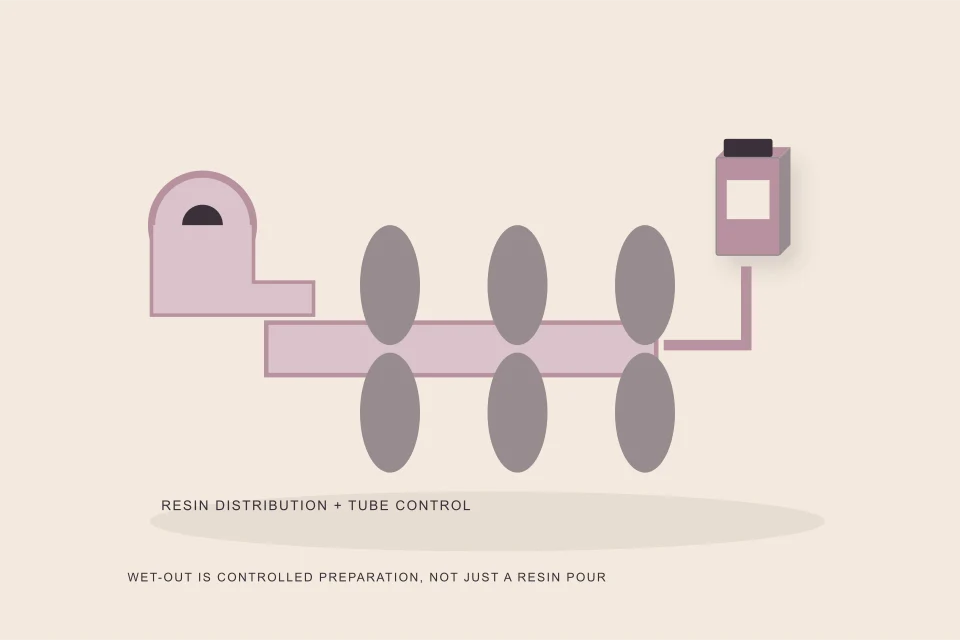
Wet-out is the step where the dry liner tube is saturated with a measured volume of mixed resin, usually under vacuum, then passed through calibration rollers that spread it evenly to a set thickness. ASTM F1216, as summarised in the Iowa SUDAS manual, calls for 5 to 10% more resin than the tube holds. Heat-cure tubes are then kept cool until installation.
- Resin volume is calculated from the tube’s dimensions, plus the 5 to 10% extra F1216 calls for.
- Vacuum pulls air out of the fabric so resin can replace it; trapped air becomes a dry spot.
- Calibration rollers set the wet thickness and push resin evenly along the tube.
- Once mixed, the resin’s working time is running; heat-cure tubes are refrigerated or iced.
- Starved, uneven or over-warm wet-out builds defects into the liner before it reaches the pipe.
01 /What is wet-out in pipe relining?
Wet-out, or impregnation, is the step that loads the resin into the fabric tube. It happens before installation, either in a factory or plant, where tubes are wet out under controlled conditions and shipped to site, or on site from a trailer or truck, just before the tube goes in. The Iowa SUDAS manual describes the traditional sequence: just before delivery to the project, the felt tube is thoroughly wetted with a thermosetting resin, and as the resin is applied the tube is turned inside out, so the membrane ends up on the outside and the resin-soaked felt on the inside.
Nothing in the finished liner can be better than its wet-out. The resin is the matrix that makes the tube a pipe, so every part of the tube needs the right amount, evenly spread, with no air left behind. A liner that is perfectly inverted and cured can still carry a dry streak or a thin band that was built in on the wet-out table.
02 /How much resin goes into a liner?
Enough to fill every void in the fabric along the whole tube, plus an allowance for resin that will leave the tube during installation. The base volume comes from geometry: the tube’s length, its diameter and its wall thickness give the volume of fabric, and the fabric’s porosity gives the share of that volume resin must fill. Manufacturers publish resin-per-metre figures for each tube size.
The allowance is set by the standard. SUDAS explains that the pressure head used to invert the tube squeezes some resin out of the felt into leaky joints and cracks, and that ASTM F1216 addresses this by requiring an additional 5 to 10% by volume of resin beyond the tube’s saturation point. That extra is not waste: resin pressed into joints helps seal them. Too little, and the tube is left starved where it lost resin; too much, and excess resin pools or forms ridges.
| Factor | Effect on the charge |
|---|---|
| Tube length and diameter | Directly proportional; measured from the camera record |
| Tube wall thickness | Thicker felt holds more resin per metre |
| Fabric porosity | Set by the tube product; from the manufacturer |
| Installation method | Inversion presses resin outward, hence the 5 to 10% allowance in F1216 |
| Host pipe condition | Many open joints and cracks take up more resin |
03 /Why is a vacuum used during wet-out?
A dry felt or glass fabric is full of air. If resin is simply poured in, air is trapped in pockets that the resin flows around, and each pocket becomes a dry or porous spot in the cured wall. Drawing a vacuum on the tube before and while the resin goes in pulls that air out, so resin replaces it. The impermeable membrane on the tube is what makes this possible: it holds the vacuum.
Vacuum impregnation also helps resin travel along a long tube. The resin charge is usually introduced at one end and drawn or rolled toward the other. The crew watches for the resin front and for any section that is not wetting, which shows as a lighter colour through a translucent membrane or as a different feel under the rollers.
04 /What do the calibration rollers do?
Calibration rollers are a pair of rollers with an adjustable gap. The resin-charged tube is fed between them, and the rollers squeeze resin forward along the tube, spread it evenly through the fabric, and set the wet thickness to match the gap. They also push any remaining air ahead of the resin front. The gap is chosen from the tube thickness and resin volume; a gap set too tight squeezes resin out of the fabric, too loose leaves uneven, thick bands.
Some facilities run tubes through rollers more than once or use rollers combined with vacuum and resin pumps. The principle is the same: the goal is a tube uniformly saturated along its full length, with the wet thickness the design expects. Ask whether wet-out is done by machine with a recorded resin volume, and whether the calibration gap is recorded with the job.
05 /Why are wet liners kept on ice?
Because a heat-cured resin starts to react as soon as its catalyst is mixed in, and warmth speeds that reaction. SUDAS notes that, since the resin cures in the presence of heat, the wet tube may be shipped in a refrigerated truck or packed in ice if weather conditions dictate. A tube that warms up in transit or waits too long in the sun can begin to gel before it is inverted, and a partly gelled tube will not invert smoothly or seat against the wall.
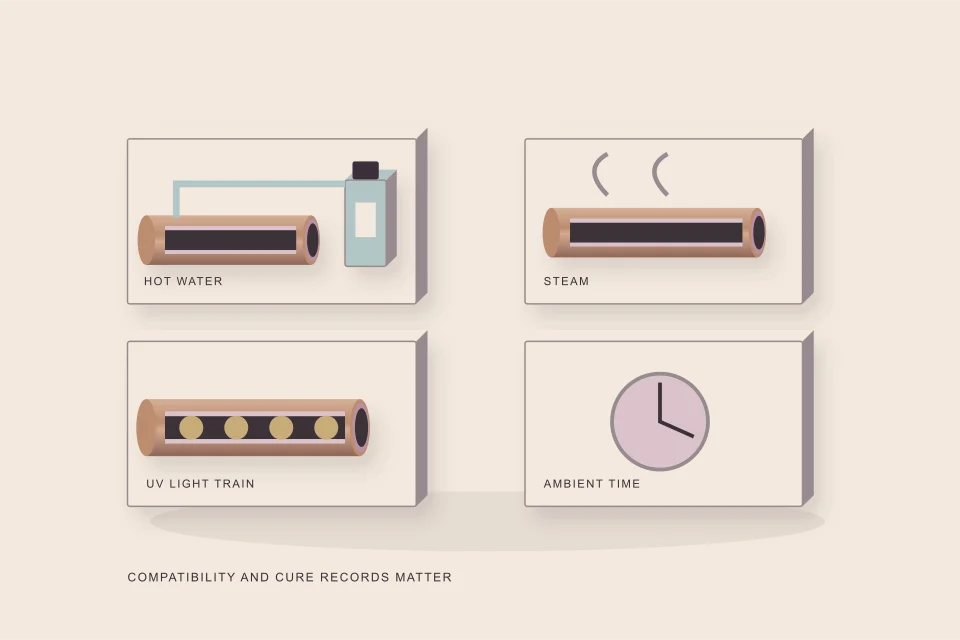
Every resin system has a working time at a given temperature, sometimes called pot life. For two-part epoxies the clock starts at mixing, and the tube must be installed and pressurised within that window. Photo-initiated resins for UV curing are formulated to stay largely unreacted until the lamps arrive, which changes the handling. Ask the installer what the working time is at the day’s temperature, and what happens if there is a delay.
06 /Plant wet-out or site wet-out?
Neither is right or wrong. A small lateral system wet out on the tailgate with a vacuum, a metered resin charge and rollers can be as sound as a factory tube, provided the steps are followed and recorded. The questions are the same: how much resin, how evenly, how much air, and how warm it got before it went in.
07 /What wet-out records should I ask for?
Ask for the resin system and batch, the volume of resin used against the calculated charge, the date and time of wet-out, the calibration gap if rollers were used, and how the tube was stored until installation. None of this is exotic; a careful installer records it as a matter of course. It turns "the liner was wet out properly" from a claim into evidence, and it is the first place to look if a dry spot or soft area appears on the final video.
08 /What defects come from bad wet-out?
- Dry spots: fabric left without enough resin, from trapped air or a starved section. They show as rough, porous or discoloured areas and are weak points.
- Thin and thick zones: an uneven charge or roller gap leaves bands of different wall thickness.
- Early gel: a heat-cure tube that warmed before installation may not invert cleanly or seat tight, leaving folds or an annular gap.
- Resin-rich ridges: too much resin, pooled in one place, can cure as a ridge that snags solids.
Most of these are visible only after the cure, on the final video, and are described with others in CIPP liner failures. The installation that follows wet-out is covered in inversion vs pull-in-place, and the tube and resin choices in CIPP liner tubes and CIPP resins. A lining quote can be read against all of these by the HAUSE Sewer desk.
FAQQuestions people ask
What does wet out mean in pipe lining?
Saturating the dry liner tube with mixed resin, usually under vacuum and through calibration rollers, before it is installed.
Why does a CIPP liner need extra resin?
Some resin is squeezed into joints and cracks during inversion. ASTM F1216 calls for 5 to 10% more resin than the tube holds to allow for it.
Can a wet liner tube be stored overnight?
Only within the resin’s working time at the storage temperature. Heat-cure tubes are refrigerated or iced; ask the installer about the specific system.
Is it better to wet out a liner in a factory?
A plant gives closer control, but a well-equipped site wet-out with measured resin, vacuum and rollers can produce an equally sound tube.
NETWORKGo deeper across the HAUSE Sewer network
Commercial and municipal sewer jetting: combination trucks, interceptors and schedules
Commercial sewer jetting explained: jet-vac combination trucks, high-flow mains cleaning, restaurant grease lines, interceptors and confined space rules.
PipeCleaning.caHow long cast iron drain pipes last, and when to repair, line or replace
How long do cast iron drain pipes last? Why they rust and crack, how to judge remaining life, and when a repair sleeve, lining or replacement is right.
SewerRoots.caSewer lining for tree roots: will a CIPP liner stop them for good?
Sewer lining for tree roots: how a CIPP liner seals root-damaged joints, which lines qualify, preparation, weak points at the ends, and planning costs.