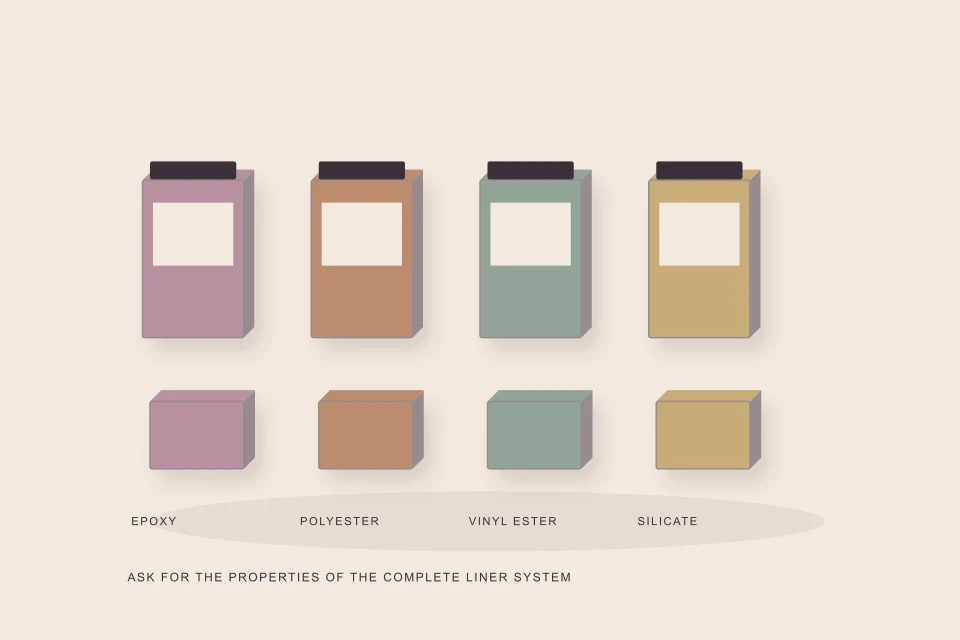
A CIPP liner is hardened by a thermosetting resin. The US EPA names unsaturated polyester, vinyl ester and epoxy as the resins commonly made for lining, each with its own chemical resistance to wastewater. Polyester and vinyl ester are usually thinned with styrene, which causes the familiar odour; epoxy is a different chemistry. Silicate systems are sold as styrene-free for short liners and connection repairs.
- Resin turns the tube into a pipe: it is liquid during installation and permanently solid after the cure.
- Polyester, vinyl ester and epoxy are the three families the EPA lists; ASTM D5813 grades CIPP systems by resin.
- Styrene thins polyester and vinyl ester and takes part in the cure, and it is the source of the plastic smell.
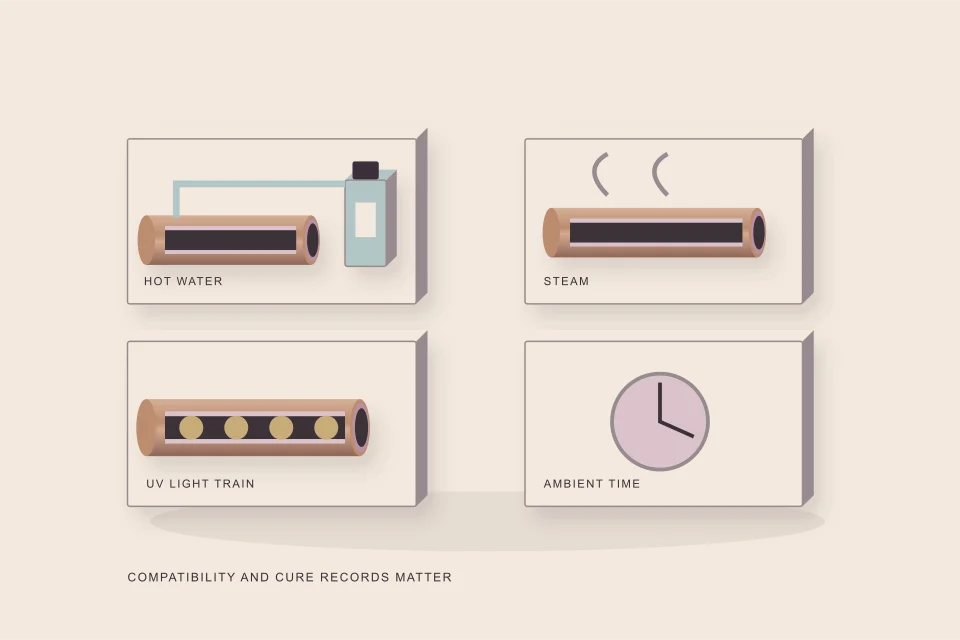
- Ultraviolet systems use photo-initiated resins that cure under a lamp train rather than heat.
- The resin’s tested flexural modulus and long-term properties feed the liner thickness calculation, so ask for them.
01 /What does the resin do in a sewer liner?
The resin is what turns a soft fabric tube into a rigid pipe. It goes in as a liquid, soaks through the tube and, when triggered by heat, ultraviolet light or its own chemistry, cross-links into a solid that cannot be melted again. That is what "thermosetting" means. The Iowa SUDAS manual puts it plainly: the resin is what hardens and ultimately gives the CIPP its strength, and the property a designer most needs from it is the flexural modulus, its stiffness in bending.
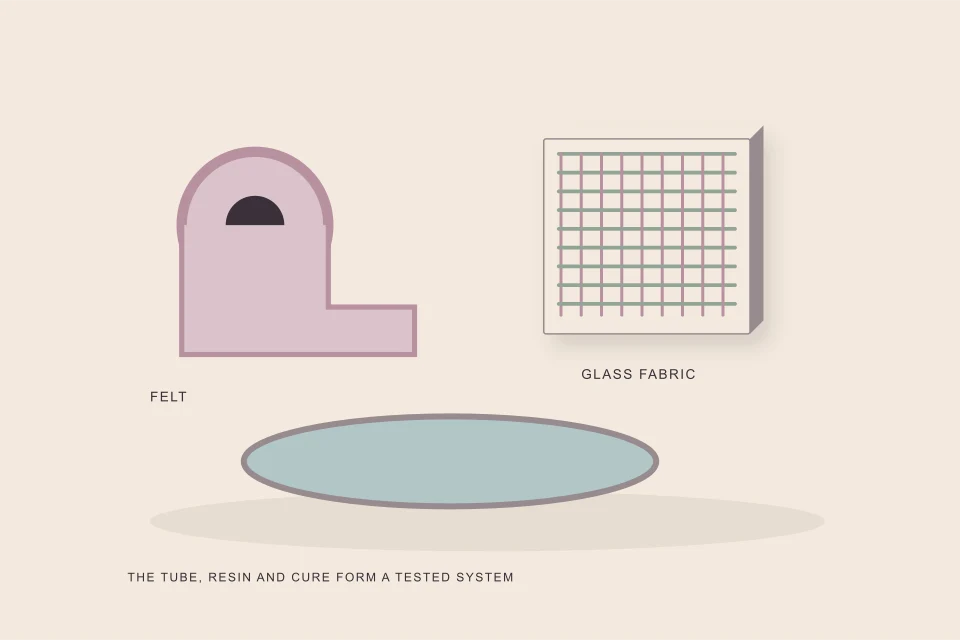
Resin also controls how the job runs. It sets how long the wet tube can wait before installation, what cure method is needed, how the site smells, and how the finished wall stands up to what flows through it. Choosing a resin is therefore less a matter of "best" than of matching a tested system, tube plus resin plus cure, to the pipe, the flow and the conditions.
02 /What are the main CIPP resin families?
The US EPA fact sheet on trenchless rehabilitation says the commonly manufactured resins are unsaturated polyester, vinyl ester and epoxy, each with distinct chemical resistance to domestic wastewater. ASTM D5813, the specification for CIPP sewer piping systems, classifies systems by resin grade, with polyester and epoxy among the grades it lists.
| Resin | How it cures | Styrene-based? | Where it is typically used |
|---|---|---|---|
| Unsaturated polyester | Heat (hot water or steam), or light when photo-initiated | Commonly | Municipal mains and laterals; the long-established workhorse |
| Vinyl ester | Heat, or light when photo-initiated | Commonly | Where more chemical resistance is wanted; UV glass liners |
| Epoxy | Two parts mixed; heat or ambient | No, a different chemistry | Widely marketed for laterals and building drains |
| Silicate (organo-mineral) | Supplier-specified; variants for warm and cold conditions | Sold as styrene-free | Connection repairs and short liners, per suppliers |
The table describes families, not products. Two polyester systems can differ more from each other than a polyester and a vinyl ester, because additives, fillers and catalysts change the result. Whatever the family, the design must use the tested values for the specific system being installed.
03 /Why do polyester and vinyl ester use styrene?
Styrene plays two parts. A 2025 study in the journal Materials on styrene-free vinyl ester resins for CIPP describes it as both a solvent that lowers the viscosity of the uncured resin, so it can soak into the tube, and a cross-linker that becomes part of the cured network. The same paper calls vinyl ester one of the most commercially significant resins for lining, noting its competitive cost, low viscosity and rapid curing.
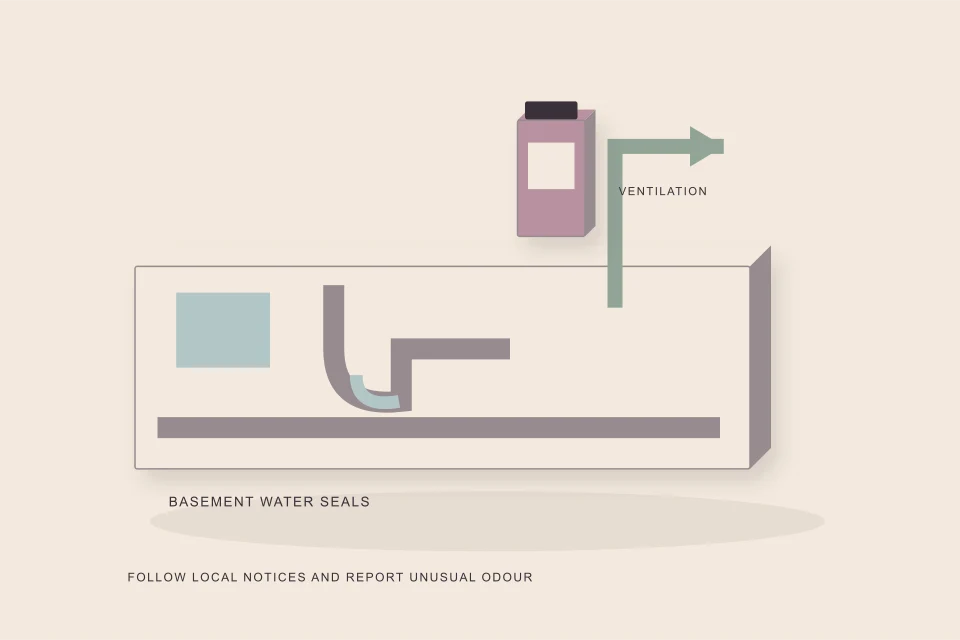
Styrene is also what people smell during lining. The City of Toronto explains that CIPP relining uses a resin containing styrene, that it releases an odour often likened to glue or plastic when heated during the cure, and that the odour can be detected at concentrations far below those associated with harmful health effects. For crews, the National Institute for Occupational Safety and Health (NIOSH) has reported that emissions from CIPP sites are a mixture of vapours, droplets and particles and recommended controls to limit inhalation and skin exposure. What that means for a house is covered in CIPP lining smell and styrene.
04 /What about epoxy sewer liners?
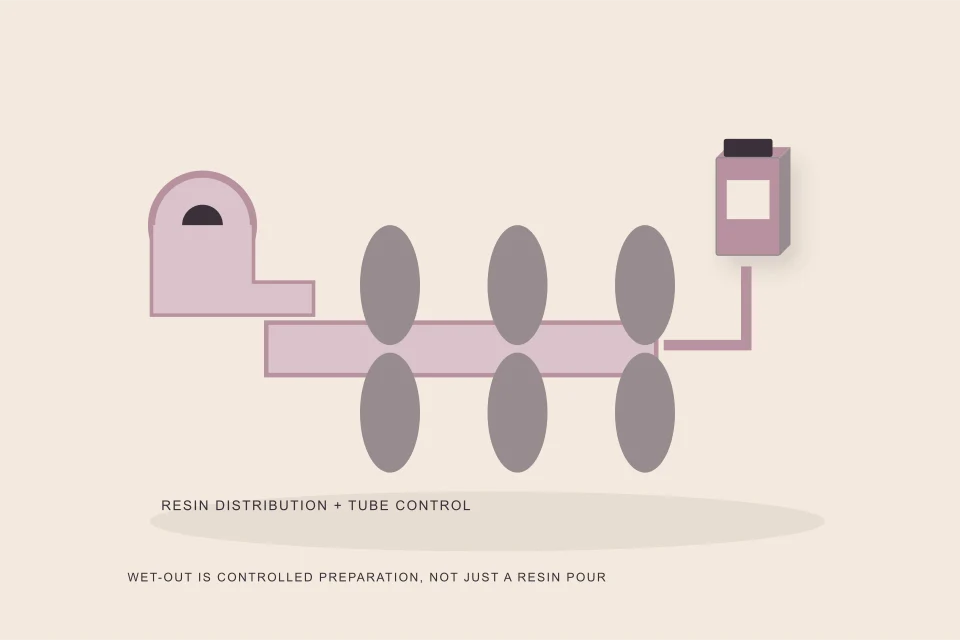
Epoxy resins cure by the reaction of two components, a resin and a hardener, mixed in set proportions just before wet-out. Once mixed, the clock starts: the working time depends on the formulation and temperature, and heat shortens it. Epoxy systems can be formulated to cure at ambient temperature or with added heat, which gives flexibility on a single house line launched from a cleanout. Epoxy is not thinned with styrene, which matters where odour inside a building is a concern.
Search results for "sewer epoxy liner" mix two different things. An epoxy CIPP liner is a fabric tube saturated with epoxy and cured in place; it has a designed wall thickness like any other liner. An epoxy coating is sprayed or brushed onto the pipe wall with no tube, and is described by a film thickness. Ask which you are being quoted, and read what sewer relining is for the wider list of lining methods.
05 /Where do silicate resins fit?
Silicate, or organo-mineral, resins are a smaller, newer family. Suppliers present them for lateral connection repairs and short liners, describe them as free of volatile organic compounds and completely styrene-free, and offer variants for higher and lower installation temperatures, including subarctic conditions. Those are manufacturers’ descriptions; as with any resin, ask for independent test data on the specific system and how its properties were used in the design.
In practice a homeowner is most likely to meet silicate resin in a connection seal or a short sectional liner rather than a full-length lateral. That is consistent with how its suppliers position it, and it is a reasonable question to ask when a quote includes sealing branch connections after lining. See reinstating connections after lining.
06 /How do UV resins differ?
Ultraviolet curing needs a photo-initiated resin: a formulation containing compounds that start the cross-linking reaction when struck by light of the right wavelength. ASTM F2019 describes glass-reinforced tubes with such a resin, pulled into place, inflated with air and cured by UV light, and ASTM F1216 and F1743 now include photo-initiated curing alongside hot water and steam. The 2025 Materials study describes both routes for vinyl ester resins: thermal curing with a steam or hot-water system, or photochemical curing with UV or LED sources.
A practical consequence is that a photo-initiated resin is designed to stay largely unreacted until the lamps arrive, so the wet tube is handled differently from a heat-cure tube that must be kept cold. The cure is controlled by lamp power and the speed of the lamp train. CIPP curing methods compares all four cures.
07 /How does the resin affect the liner design?
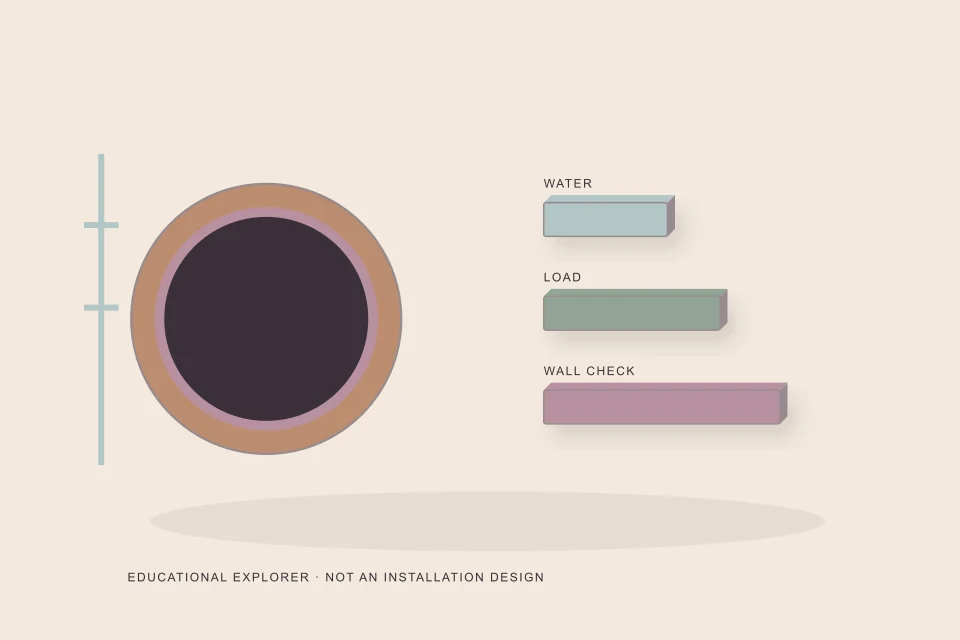
The liner thickness equations take the resin’s flexural modulus as an input. SUDAS lists 250,000, 300,000 and 400,000 psi as common short-term values and applies a reduction, normally 50%, for creep over the liner’s life to get the long-term modulus used in design. A stiffer resin system gives a thinner required wall for the same load. The Liner Thickness Explorer lets you switch between those three values and see the effect.
Because of that, SUDAS advises owners not to lock a project into one resin and one thickness, but to allow combinations that meet the design, since the most economical pairing differs between contractors. For a homeowner the lesson is the same in reverse: when two quotes name different resins, the thicknesses may legitimately differ too.
- Which resin family and which specific system is it?
- Is it styrene-based, and how is odour managed indoors?
- What short-term and long-term flexural values were used in the design, and where are they tested?
- How is the resin stored, mixed and wet out, and what is its working time at site temperature?
- What cure does it need, and will I receive the cure record?
For costs, see the sewer relining cost page; resin choice is one of several items that move a lining price. To have a lining quote read, send it to the HAUSE Sewer desk.
FAQQuestions people ask
Is epoxy or polyester better for a sewer liner?
Neither is better in every case. They differ in cure, handling, odour and chemical resistance; the right one is the system the design and tests were done with for your line.
Why does a relined sewer smell like plastic?
Styrene in polyester and vinyl ester resins gives off an odour during curing. Cities that line their sewers describe it as temporary.
Do all CIPP resins contain styrene?
No. Polyester and vinyl ester commonly do. Epoxy uses a different chemistry, and silicate systems and some newer vinyl esters are sold as styrene-free.
What is a photo-initiated resin?
A resin that starts curing when exposed to light of the right wavelength, used with UV lamp trains in UV-cured liners.
Can resin leak out of the liner into the soil?
Some resin is pressed into open joints and cracks during inversion, which is why extra resin is allowed for. A preliner or outer membrane limits migration where that is a concern.
NETWORKGo deeper across the HAUSE Sewer network
Sewer lining for tree roots: will a CIPP liner stop them for good?
Sewer lining for tree roots: how a CIPP liner seals root-damaged joints, which lines qualify, preparation, weak points at the ends, and planning costs.
SewerInspector.caHow long a sewer scope takes, from booking to the report
How long a sewer scope inspection takes: typical time on site, what adds time, how far ahead to book, and when to expect the video and the written report.
PipeCleaning.caCleaning ABS and PVC drain pipe safely
How to clean ABS and PVC drain pipe: safe auger heads and jet nozzles for plastic, why chemical cleaners and heat are risky, and how to protect joints.
SOURCESSources and further reading
- US EPA — Collection Systems O&M Fact Sheet: Trenchless Sewer Rehabilitation
- Materials (2025) — The Effect of Photoreactive Diluents on the Properties of a Styrene-Free Vinyl Ester Resin for CIPP
- City of Toronto — Styrene Used in Sewer Relining
- Iowa SUDAS Design Manual, Section 14C-2
- Trelleborg — Silicate resin systems (manufacturer description)