This glossary defines the words that appear in sewer relining quotes, camera reports and design calculations, from cured-in-place pipe, host pipe and wet-out to inversion, ovality, dimension ratio, enhancement factor, reinstatement and delamination. Each definition is written to stand on its own and links the idea to how a liner is made, installed, designed or inspected.
- Terms are grouped loosely by materials, installation, design and inspection, then listed alphabetically below.
- Design terms follow the ASTM F1216 appendix as published in the Iowa SUDAS design manual.
- Where a term has more than one common name, both are given.
01 /How to use this glossary
Lining quotes are dense with trade terms, and the same idea can have several names: a sectional liner is also a point repair or spot liner; a calibration hose may be called a bladder or an inversion hose depending on the system. The definitions below favour the plain meaning and note alternatives. Where a term comes from a standard, the standard is named so you can ask the installer which one their work follows.
For the method in context, start with what sewer relining is and how sewer relining works. Design terms such as ovality, enhancement factor and dimension ratio are used in the Liner Thickness Explorer and explained in liner thickness and ASTM F1216. Short answers to common questions are in the relining FAQ.
A–ZTerms
- Access pit
- A small excavation dug to reach a pipe where no cleanout exists, so a liner can be launched or finished.
- Access point
- Any opening a liner or tool can be launched from: a cleanout, a manhole or an access pit.
- Ambient cure
- Curing a resin at the temperature of the pipe and ground, with no added heat; slower in cold conditions.
- Annulus
- The thin gap between a liner and the host pipe. Good installation keeps it as small as possible and sealed at the ends.
- ASTM D5813
- The ASTM specification for cured-in-place thermosetting resin sewer piping systems, classifying liners by resin grade and structural type.
- ASTM F1216
- The ASTM practice for installing a liner by inversion and curing it with hot water, steam or a photo-initiated reaction; its appendix holds the common design equations.
- ASTM F1743
- The ASTM practice for pulling a resin tube into place and inflating it with a calibration hose before curing.
- ASTM F2019
- The ASTM practice for pulled-in, glass-reinforced liners cured by ultraviolet light.
- ASTM F2561
- The ASTM practice for a one-piece liner that renews a lateral and its connection to the main.
- ASTM F2599
- The ASTM practice for sectional repair of a damaged pipe with a short inverted cured-in-place liner.
- B′ (coefficient of elastic support)
- A design term for how much the surrounding soil supports a fully deteriorated liner; it increases with depth.
- Bending check
- A design check that the bending stress in an oval liner under groundwater stays below its long-term flexural strength.
- Bladder
- An inflatable sleeve that holds a short resin tube against the pipe wall until it cures, mostly used for sectional repairs.
- Buckling
- Sudden inward collapse of a thin liner under external pressure, usually groundwater; the main design case for partially deteriorated pipe.
- Bypass
- Diverting flow around the section being lined; on a house lateral it simply means no water use during the work.
- Calibration hose
- An inner hose inverted or inflated inside a pulled-in tube to press it against the host wall during the cure.
- Calibration rollers
- A pair of rollers with a set gap that spread resin evenly through a tube during wet-out and set its wet thickness.
- Connection seal
- A short brimmed liner pressed into a branch so the brim bonds onto the lined pipe and seals the junction; also called a top hat.
- Cool-down
- Lowering a heat-cured liner’s temperature under pressure before release, so it sets in shape.
- Creep
- Slow deformation of a plastic under constant load; design allows for it by using a long-term modulus.
- Cure record
- The log proving a liner was cured as required: temperatures and times for heat cures, lamp power and speed for UV.
- Cured-in-place pipe (CIPP)
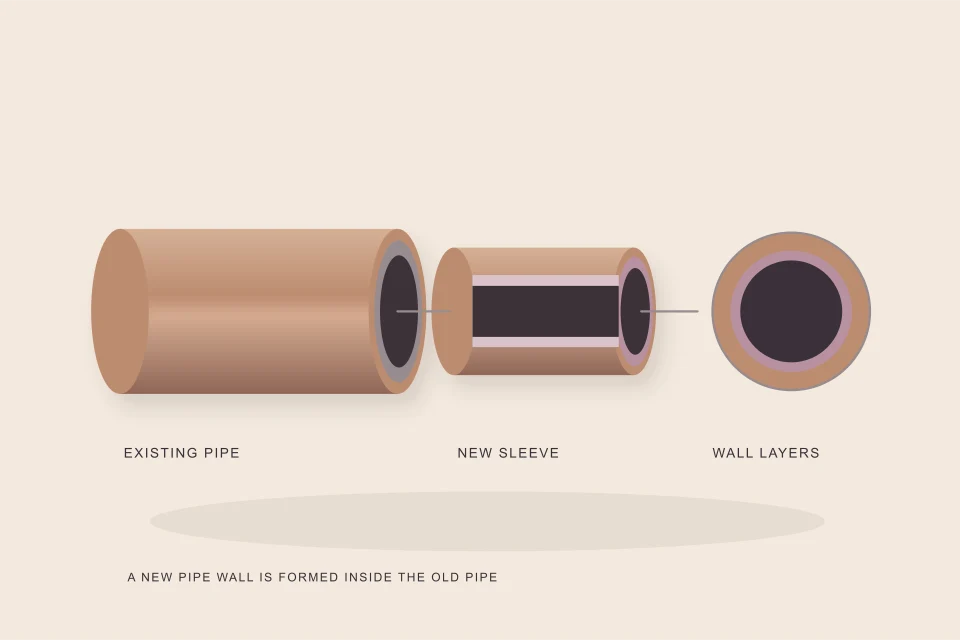
- A pipe formed inside an existing pipe from a resin-saturated tube that is pressed against the wall and hardened in place.
- Delamination
- Separation of layers within a liner wall, or of the inner coating from the cured tube.
- Descaling
- Removing tuberculation and scale from cast iron with chains or cutting heads, back to sound metal, before lining.
- Design life
- The service period a liner is designed to reach; the SUDAS manual describes 50 years as generally accepted for CIPP.
- Dimension ratio (DR or SDR)
- Liner outside diameter divided by wall thickness; a lower DR means a thicker, stiffer wall.
- Dimple
- The slight depression a cured liner leaves over a branch opening, used to locate it for reinstatement.
- Dry spot
- An area of tube left without enough resin, usually from trapped air or a starved wet-out; a weak point.
- E′s (modulus of soil reaction)
- A design input for the support the surroundings give a fully deteriorated liner; SUDAS suggests 500 to 2,000 psi.
- End seal
- The treatment at each end of a liner that stops water running into the annulus.
- Enhancement factor (K)
- A design term for the support the soil and old pipe give a liner against buckling; SUDAS gives 7 as typical.
- Epoxy resin
- A two-part thermosetting resin that cures when resin and hardener are mixed; not styrene-based.
- Felt tube
- A liner tube of absorbent non-woven felt, usually with a plastic membrane on one face; the classic CIPP reinforcement.
- Fin
- A fold of liner standing into the flow, usually formed at a bend or transition.
- Flexural modulus
- A material’s stiffness in bending; the resin property that drives liner thickness. SUDAS lists 250,000 to 400,000 psi as common.
- Fully deteriorated
- A host pipe that cannot carry soil and live loads; the liner is designed to carry everything on its own.
- Glass-fibre tube
- A liner tube of glass fabric, used with photo-initiated resin and UV curing under ASTM F2019.
- Host pipe
- The existing pipe a liner is installed inside.
- Hot-water cure
- Curing a liner by heating and circulating water inside it.
- Infiltration
- Groundwater leaking into a sewer through joints and cracks; lining is one of the main ways to stop it.
- Inversion
- Installing a tube by turning it inside out along the pipe under water or air pressure.
- Inversion drum
- A pressurised container that holds a wet tube and inverts it with air, common for house laterals.
- Lateral
- The sewer pipe connecting a building to the municipal main.
- Lift
- A section where a liner has moved inward away from the host pipe, usually pushed by water behind it.
- Long-term modulus
- The reduced stiffness used in design to allow for creep, normally 50% of the short-term value per SUDAS.
- Membrane (coating)
- The thin plastic layer on a liner tube that holds resin in; it ends up inside an inverted liner and outside a pulled-in one.
- Ovality
- How far a pipe is out of round, as a percentage; it reduces buckling capacity through the ovality factor.
- Ovality reduction factor (C)
- A multiplier on buckling capacity: 1.00 for round pipe, 0.64 at 5% ovality, 0.41 at 10%.
- Partially deteriorated
- A host pipe that still carries the soil for the design life, with cracks and up to 10% distortion; the liner resists groundwater.
- Photo-initiated resin
- A resin that begins curing when exposed to light of a set wavelength, used for UV curing.
- Polyester resin
- Unsaturated polyester, a widely used, usually styrene-based thermosetting lining resin.
- Preliner
- A film pulled in before the liner to separate it from groundwater, debris or large voids.
- Pull-in-place
- Installing a tube by winching it into the pipe flat and then inflating it.
- Reinstatement
- Reopening branch connections from inside a cured liner, usually with a remote-controlled cutter.
- Sectional liner
- A short cured-in-place liner over one defect; also called a point repair or spot liner.
- Silicate resin
- An organo-mineral resin family sold as styrene-free, mainly for connection repairs and short liners.
- Steam cure
- Curing a liner by introducing controlled steam into it and draining the condensate.
- Styrene
- The reactive thinner in most polyester and vinyl ester lining resins, and the source of the plastic or glue smell during curing.
- Thermosetting resin
- A resin that cures permanently into a solid and cannot be re-melted.
- Tuberculation
- Rusty nodules growing from the inside wall of cast iron pipe, narrowing the bore.
- UV cure
- Curing a photo-initiated resin with a train of ultraviolet lamps pulled through the inflated liner.
- Vinyl ester resin
- A thermosetting resin valued in CIPP for low viscosity and rapid curing; usually styrene-based.
- Wet-out
- Saturating a dry liner tube with a measured charge of mixed resin, usually under vacuum, before installation.
- Wrinkle
- A ridge in a cured liner where excess tube bunched, commonly at bends and diameter changes.
FAQQuestions people ask
What is the host pipe in sewer relining?
The existing pipe the liner is installed inside. It stays in the ground and acts as the mould for the new liner.
What does SDR mean on a liner quote?
Standard dimension ratio: the liner outside diameter divided by its wall thickness. Lower means thicker.
What is the annulus in a lined pipe?
The thin gap between the liner and the old pipe. It should be small and sealed at the ends so water cannot run behind the liner.