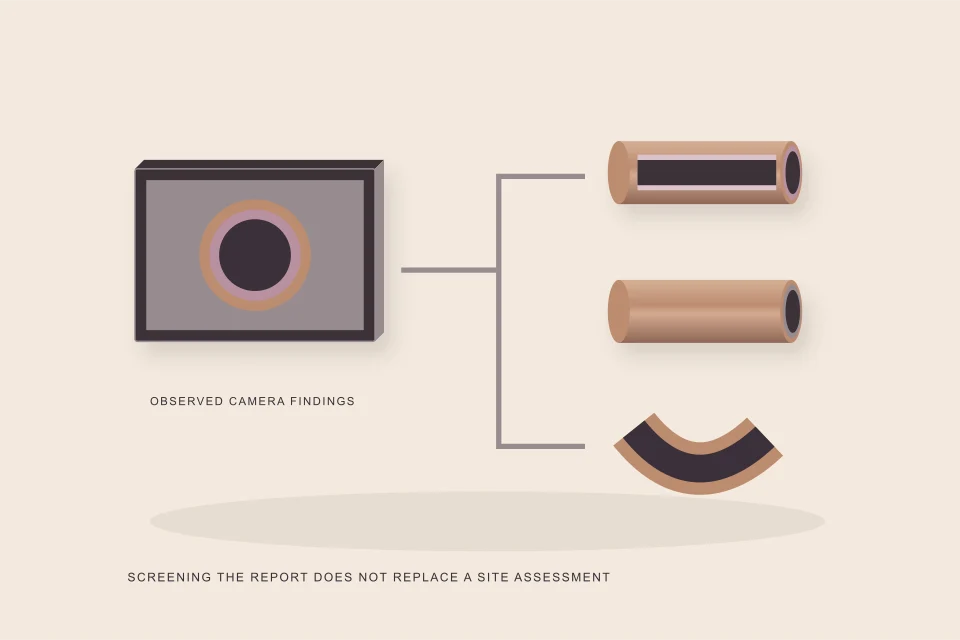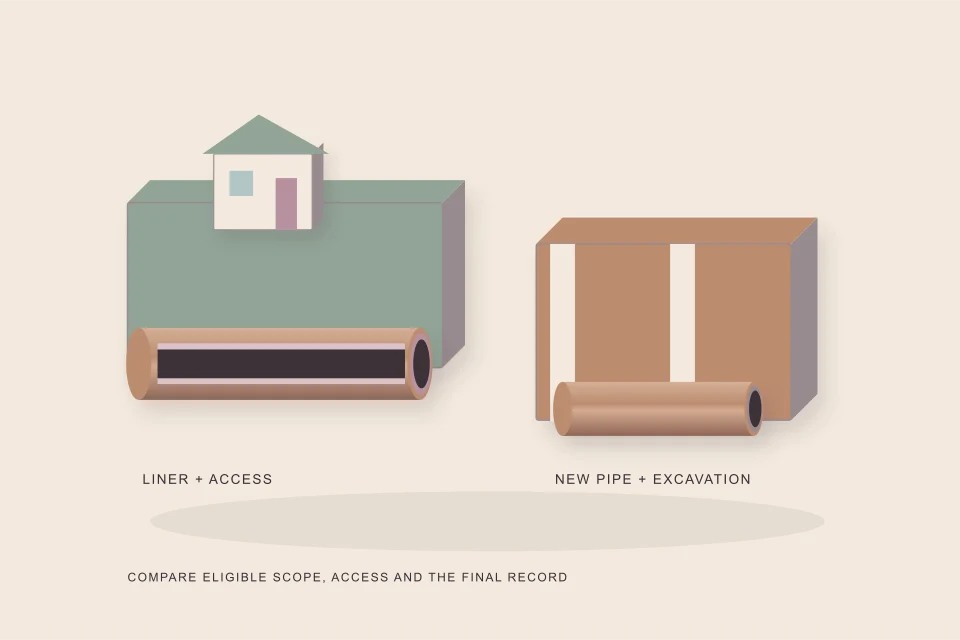
Relining is usually worth it when the pipe is round and passable but leaking, root-invaded or cracked, and when digging would go under driveways, trees, finished floors or deep ground. You get a jointless pipe designed for a long service life without a trench. It is poor value where the grade is wrong, the pipe has collapsed, a short shallow dig would be cheaper, or more capacity is needed.
- A liner renews the pipe wall; it does not change grade, route or capacity.
- As 2026 planning estimates, a full liner on a 15 to 25 m lateral quotes $9,000 to $28,000; open-cut replacement $12,000 to $35,000 or more.
- Restoration above a trench, not the pipe, is often what makes lining the cheaper whole-job option.
- Most of a lining price is mobilisation, cleaning, the liner system and reinstatement, not the tube alone.
- Relining is widely used by Canadian cities on their own sewers; "liners are illegal" is a myth, though private-work permits vary.
01 /What do you actually get from a liner?
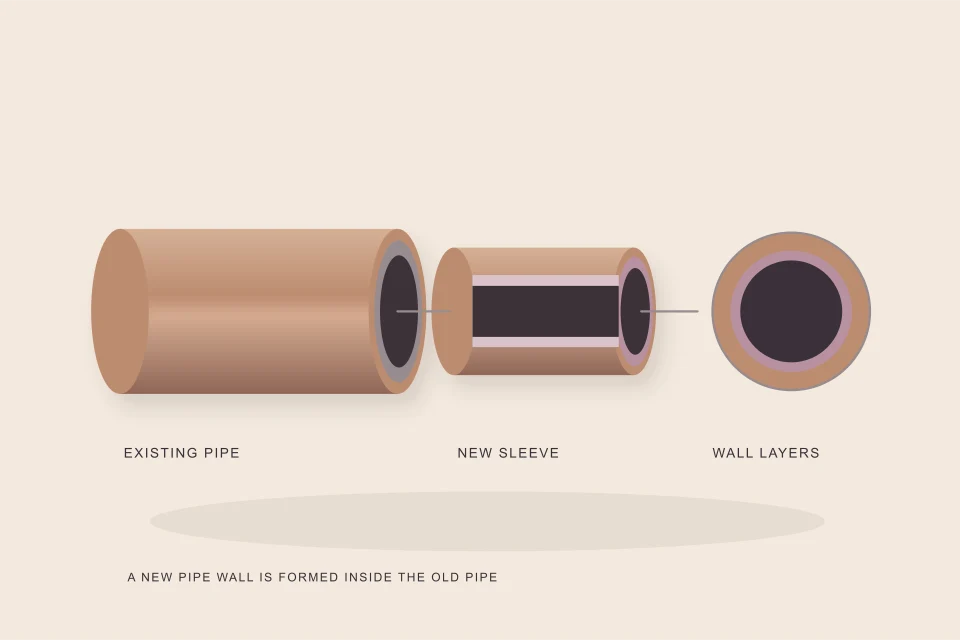
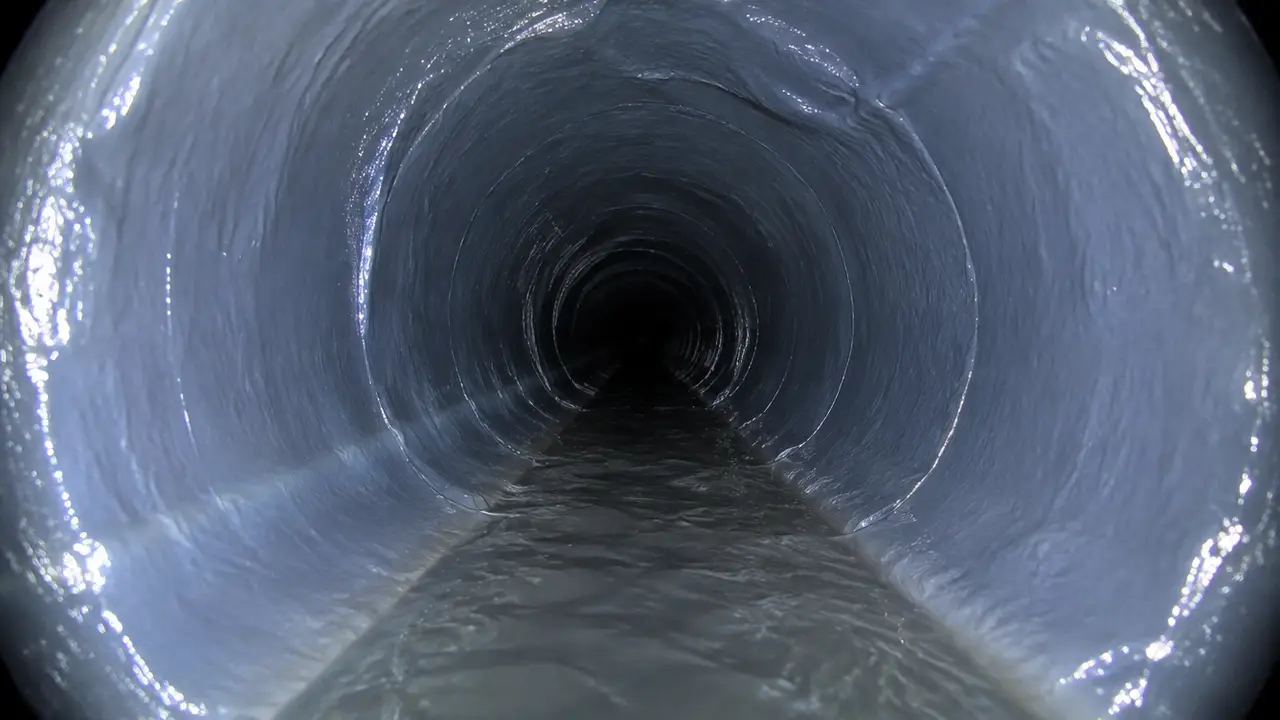
A new pipe wall inside the old one: jointless over its length, sealed against roots and groundwater, and designed for the load case the old pipe presents. The Iowa SUDAS manual describes the result as a new pipe formed within the existing one that reduces infiltration and adds structural integrity, with a service life generally accepted to be 50 years. You also get a job with no trench along the route, usually done from one or two access points.
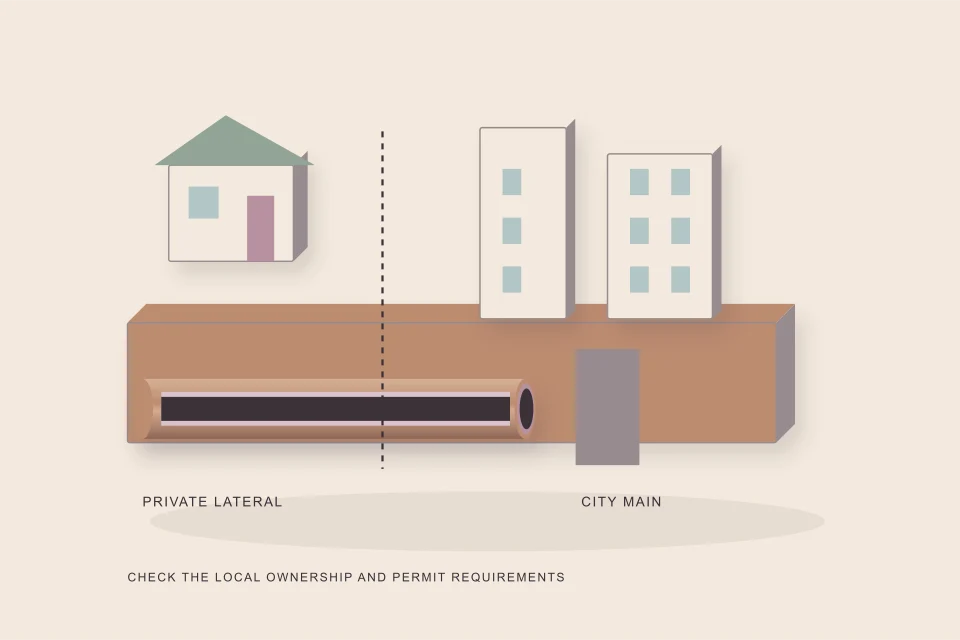
What you do not get matters as much. A liner keeps the old route, the old grade and every bend. It makes the bore slightly smaller, by twice the wall thickness. It leaves anything beyond its ends, such as the city-side section or the connection to the main, as it was. If the problem is one of those, a liner is the wrong purchase however good it is.
02 /How does relining compare with new pipe on cost?
On pipe alone, a liner is not dramatically cheaper than new pipe in an open trench. The difference is what sits above the pipe. The ranges below are the same planning estimates published on sister sites SewerQuotes.com and SewerReplacement.ca, so the comparison is consistent across the network.
| Method | Typical quoted range | What it leaves behind |
|---|---|---|
| Full-length CIPP liner | $9,000–$28,000 | Jointless liner; same grade; slightly smaller bore |
| Pipe bursting | $10,000–$30,000 | New pipe on the old path; can upsize; two or more pits |
| Open-cut replacement | $12,000–$35,000+ | New pipe on new grade; a trench to restore |
Spread over a design life, the numbers look different again. At $9,000 to $28,000 and a 50-year design life, a liner works out to roughly $180 to $560 a year of intended service, the same arithmetic SewerReplacement.ca publishes. New pipe in a trench has a long life too, but the trench’s restoration, concrete, landscaping, a finished basement floor, is paid on day one. The line items are on the sewer relining cost page.
03 /Why is pipe relining so expensive?
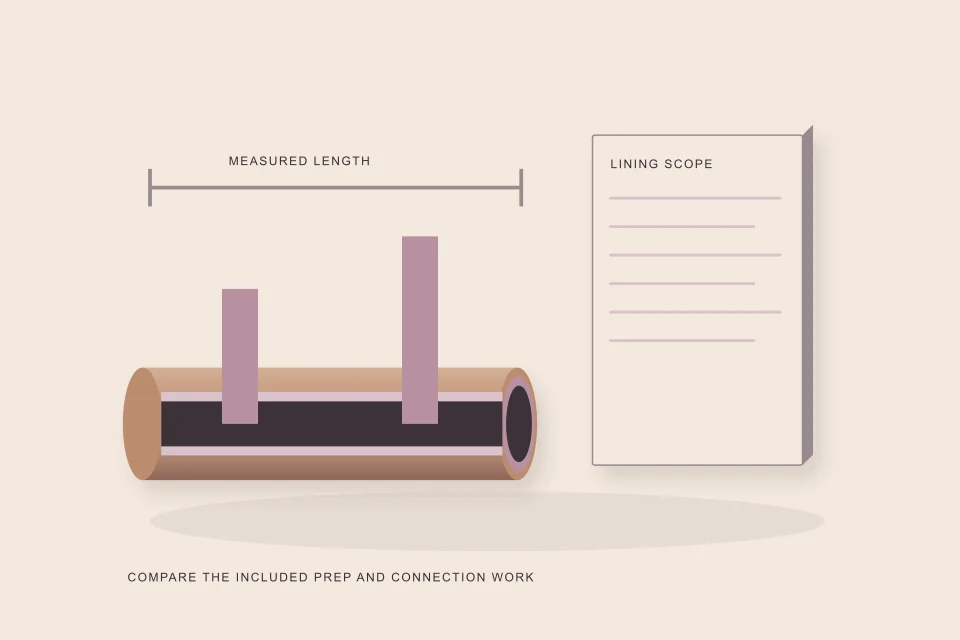
Because the price covers far more than a tube. The installed liner is a manufactured, job-sized system, and a lining job carries a crew and specialised equipment to site, cleans the pipe to a standard far above ordinary drain clearing, films it more than once, uses a manufactured tube and resin system sized for your line, cures it with heating or UV equipment, and reopens every connection with a remote cutter. Short residential jobs carry all of that fixed cost over a few metres of pipe.
- Mobilisation and setup: trucks, inversion or pull-in equipment, boiler, steam or UV rig, flow control.
- Cleaning and preparation: root cutting, descaling and jetting, often the most variable line.
- Liner and resin: priced per metre by diameter, thickness and system.
- Reinstatement: each branch connection reopened, and sealed if specified.
- Access: a new cleanout or access pit where none exists.
SUDAS notes the same effect at municipal scale: mobilisation is one of the most significant costs, and lining larger quantities in one project reduces the unit cost. For a homeowner that is a reason to line the whole problem length in one visit rather than in pieces, and to ask whether neighbours with the same era of pipe are considering it too.
04 /When is relining good value?
Whether your own line qualifies is a screening question: Can My Sewer Be Relined? applies the lining stop points to your camera findings. The decision between a liner, a dig, a spot repair and bursting for a particular fault is the lane of sister site TrenchlessSewerRepair.ca, and bursting in depth is covered by PipeBursting.ca.
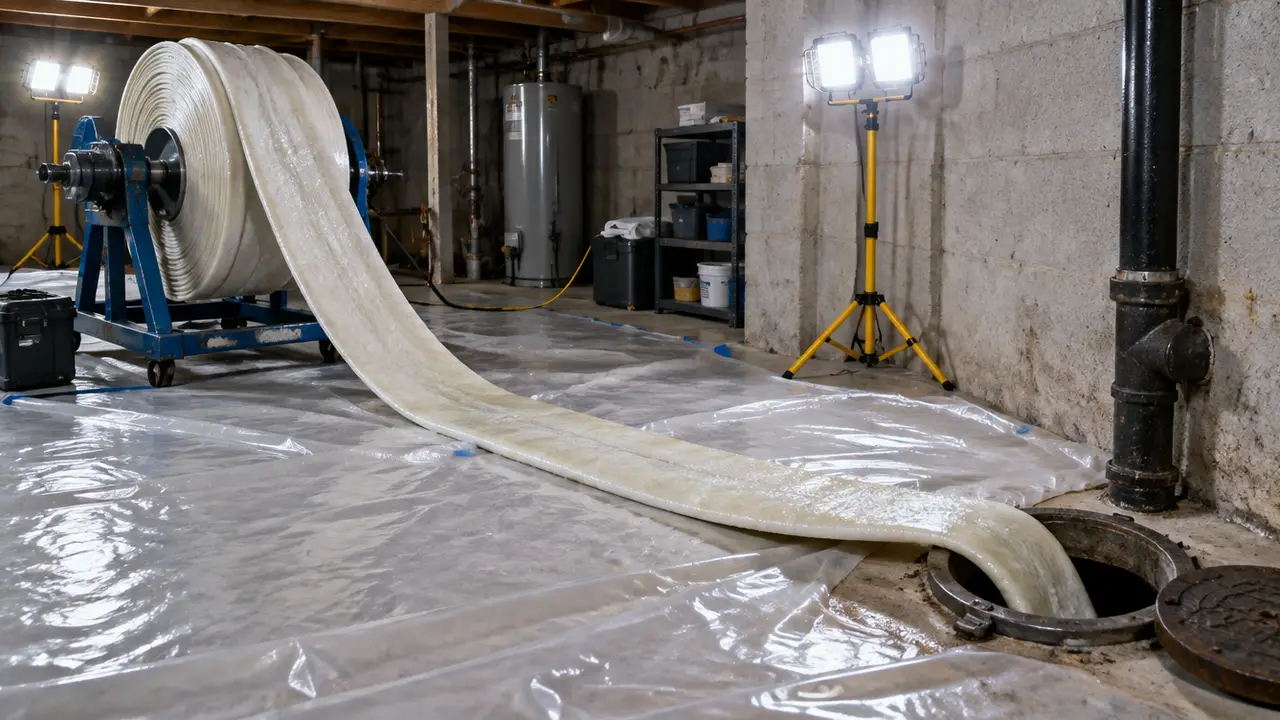
05 /Are sewer liners illegal or unreliable?
No. Searches for "sewer liners are illegal" reflect confusion, not a Canadian rule. Canadian municipalities line their own sewers routinely. The City of Calgary runs a sanitary lateral lining program that lines service pipes from the manholes; EPCOR in Edmonton reports that about 80% of its drainage rehabilitation is done by relining; the City of Winnipeg says it has used cured-in-place technology to renew sewers for decades. What does vary is whether lining a private building sewer needs a plumbing permit and inspection, which is set by the province and municipality. Confirm with your municipality, or have the contractor show it on the quote.
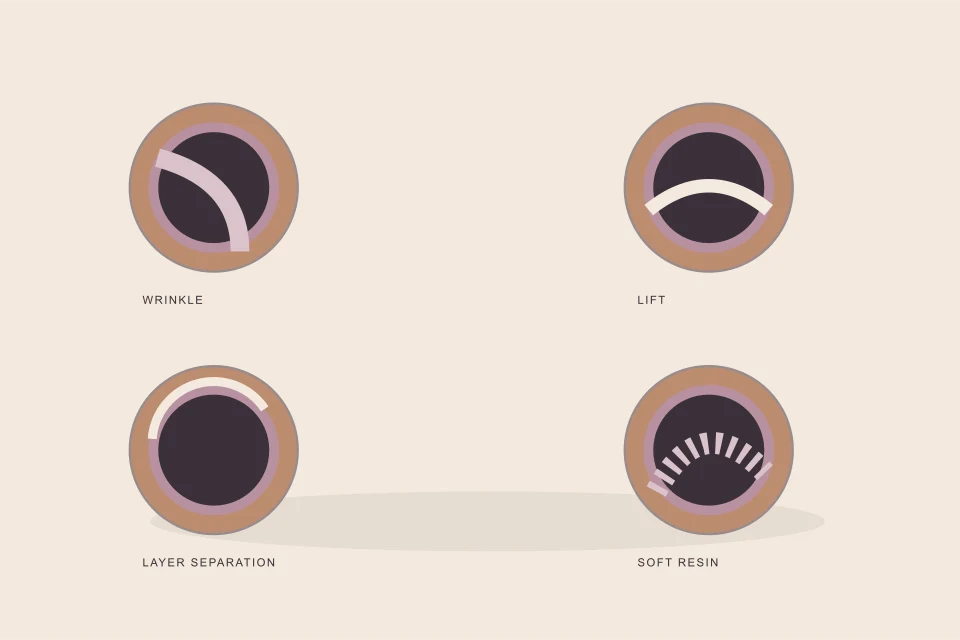
Reliability is about installation quality more than the method. The defects that give liners a bad name, wrinkles, lifts, soft spots, missed connections, are real, but they are visible on a final video and most can be fixed. They are described in CIPP liner failures, and what a service-life figure rests on is in how long sewer relining lasts.
06 /What about capacity and flow after lining?
A liner makes the bore smaller, by twice its wall thickness. For a 100 mm lateral with a liner of 1 to 3 mm, that is roughly 4 to 12% of the flow area. The Iowa SUDAS manual describes the result as a new pipe with a slightly smaller inside diameter but the same general shape. In practice, the loss of area is set against a wall that is smooth and jointless, with no roots, offsets or protruding joints to catch solids, which is why lined laterals commonly carry flow as well as the damaged pipe they replaced.
Where a line is already undersized for the building it serves, such as a house being converted to more suites, lining is the wrong answer: it cannot add capacity. Bursting, which can install a larger pipe on the old path, or replacement is the conversation, and new service connections for more units are the subject of sister site NewSewerLines.com. The Liner Thickness Explorer reports the flow area left for any diameter and wall you enter.
07 /Can a liner add value when selling a house?
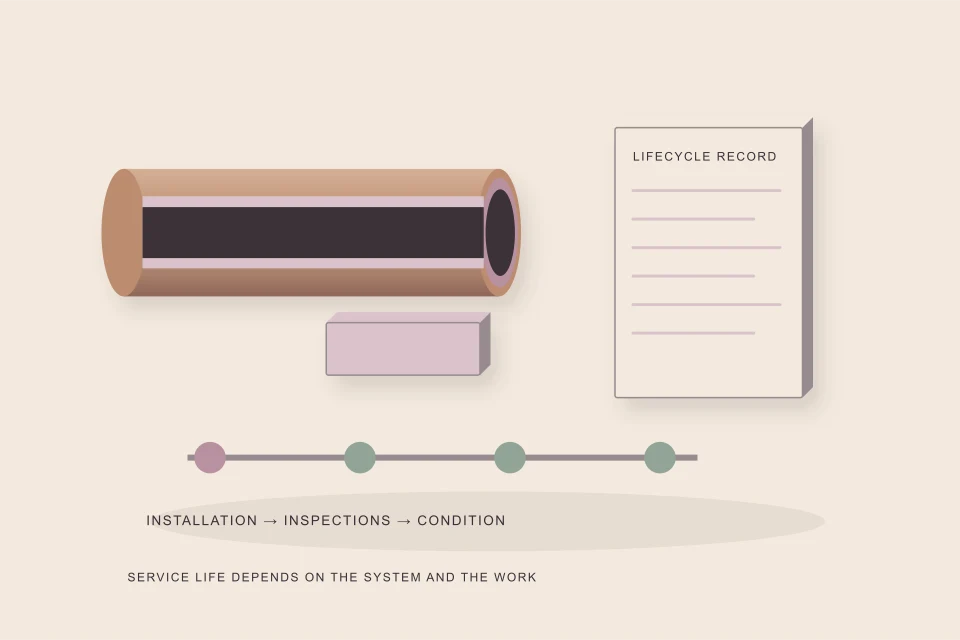
A documented liner is an answer to a question buyers and their inspectors increasingly ask about older homes: what condition is the sewer in? What makes it useful is the paperwork, not the word "lined". A buyer’s camera run that finds a liner with no records raises new questions; one with pre-lining and final video, the design details and a transferable warranty closes them. If you are relining with a sale in mind, ask for everything as files and check whether the warranty transfers to a new owner.
08 /How do I decide?
- Get a recorded camera inspection with distances; nothing can be decided without it.
- Screen it for lining stop points: collapse, belly, blocking offset.
- Price the whole job each way, including restoration above any trench and access for any liner.
- Compare what each option leaves you: grade, capacity, joints, the unlined ends.
- Ask each lining quote for the design condition, thickness, resin and cure, and the video you will receive.
If you want an independent read of a camera report or two competing quotes, send them to the HAUSE Sewer desk. HAUSE is not a contractor and does not install liners. The method itself is introduced in what sewer relining is.
FAQQuestions people ask
Is relining cheaper than replacing a sewer line?
Often, once restoration is counted. As 2026 planning estimates, a full liner on a 15 to 25 m lateral quotes $9,000 to $28,000 against $12,000 to $35,000 or more for open-cut replacement.
Why do lining quotes vary so much?
Cleaning effort, access, the number of connections, the liner system and mobilisation differ between jobs and contractors. Compare quotes line by line on the same footage.
Are sewer liners illegal in Canada?
No. Canadian cities line their own sewers. Permit and inspection rules for private lining vary by province and municipality, so confirm locally.
When should I replace rather than reline?
When the grade is wrong, the pipe has collapsed or lost its shape, you need more capacity, or a short shallow dig costs less.
NETWORKGo deeper across the HAUSE Sewer network
How long cast iron drain pipes last, and when to repair, line or replace
How long do cast iron drain pipes last? Why they rust and crack, how to judge remaining life, and when a repair sleeve, lining or replacement is right.
SewerQuotes.comSewer line replacement cost: open-cut vs trenchless, line by line
Sewer line replacement cost in Canada for 2026: open-cut, CIPP lining and pipe bursting planning ranges in CAD, per-metre math, line items and what moves price.
SewerInspector.caSewer camera inspection certification and training: what it proves
Sewer camera inspection certification and training in Canada: NASSCO PACP and LACP, home inspector courses, safety training and what a credential proves.