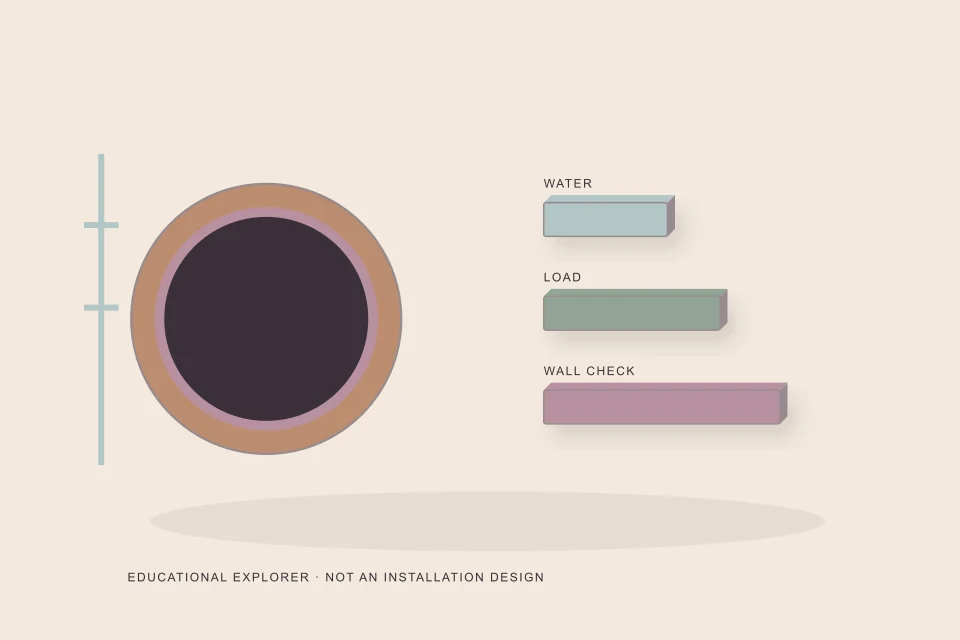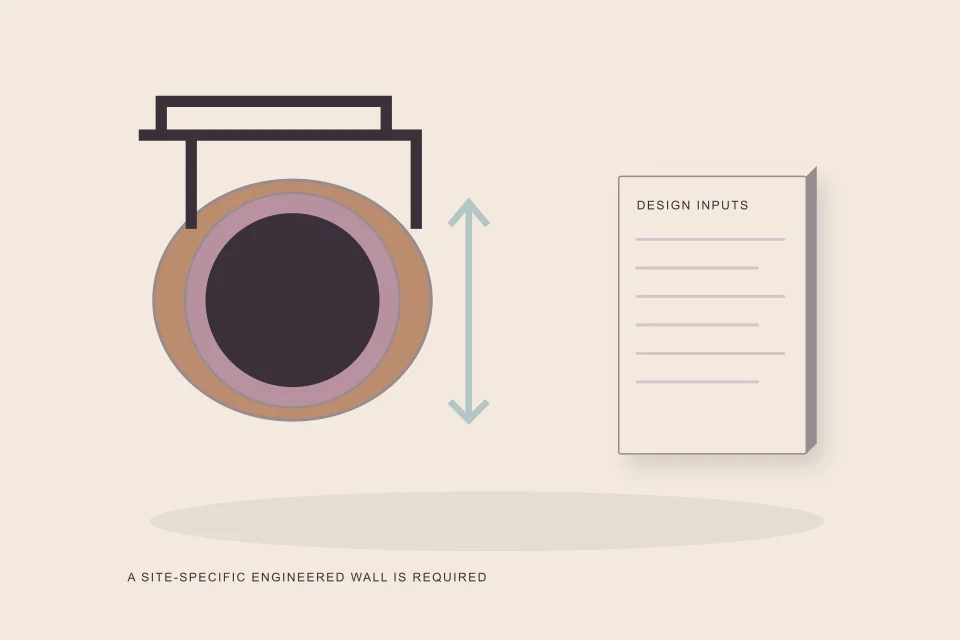
A CIPP liner’s thickness is calculated, not picked. ASTM F1216’s appendix designs it around the host pipe’s condition. For a partially deteriorated pipe, which still carries the soil, the liner must resist groundwater without buckling. For a fully deteriorated pipe the liner carries water, soil and traffic on its own and must meet a minimum stiffness. Ovality, depth and the resin’s long-term stiffness all enter.
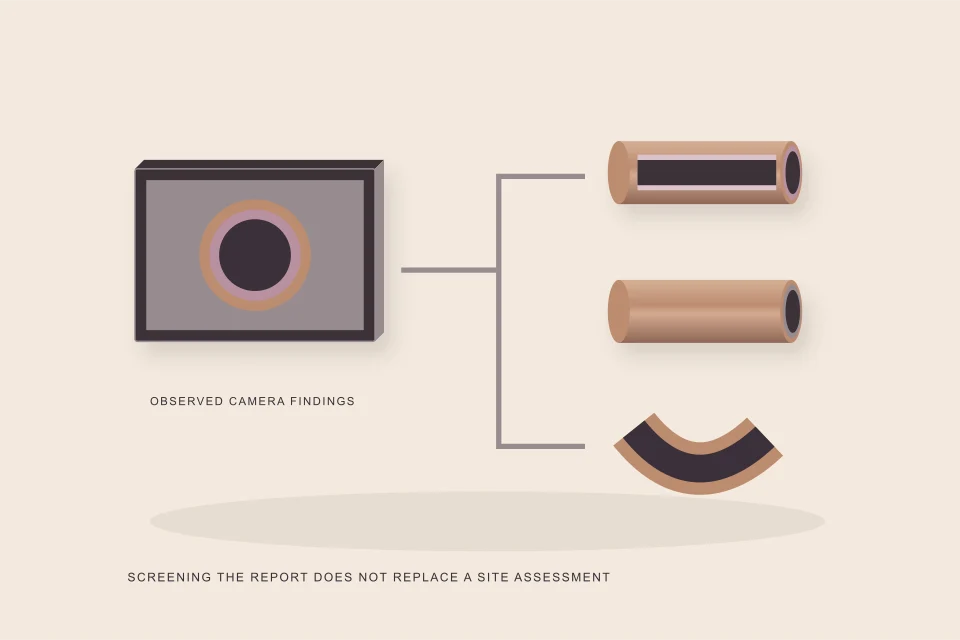
- Partially deteriorated: longitudinal cracks and up to 10% distortion; the liner is designed for groundwater.
- Fully deteriorated: missing sections, lost shape or corrosion; the liner is designed for all loads.
- Ovality cuts buckling capacity sharply: the reduction factor is 0.64 at 5% and 0.41 at 10%.
- The long-term modulus used in design is normally half the short-term value, to allow for creep.
- Cured samples can be cut or cured in a frame and tested for flexural properties and delamination.
01 /Why is liner thickness designed at all?
Because a liner is a pipe and has to stand up to the loads around it for its whole life. Groundwater presses on it from outside and can buckle a thin, flexible wall. Where the old pipe has broken down, the soil above and any traffic bear on the liner too. And a plastic composite under constant load slowly creeps, so its stiffness decades from now is lower than on the day it cured. Thickness is what balances those against the material.
ASTM F1216, the standard practice for inverted liners, contains a non-mandatory appendix of design equations that most North American specifications use, including for pulled-in liners under F1743. The Iowa Statewide Urban Design and Specifications (SUDAS) Design Manual, Section 14C-2, reproduces them rearranged to solve for thickness, with worked examples. This guide follows that source; the Liner Thickness Explorer runs the same equations.
02 /What is the difference between partially and fully deteriorated pipe?
The design starts by classing the host pipe. SUDAS quotes ASTM F1216’s definitions. A partially deteriorated pipe can support the soil and surcharge loads throughout the design life of the rehabilitated pipe, with adequate side support from the soil; it may have longitudinal cracks and up to 10% distortion of the diameter, and beyond 10% alternative design methods are required. A fully deteriorated pipe is not structurally sound and cannot support soil and live loads, or is expected to reach that condition over the design life; this is evident when sections are missing, the pipe has lost its original shape, or it has corroded.
ASTM D5813, the specification for CIPP sewer systems, uses a parallel classification: Type I liners provide chemical resistance and prevent exfiltration, Type II liners go into partially deteriorated pipe and also resist groundwater, and Type III liners go into fully deteriorated pipe and support all external hydraulic, soil and live loads. The camera record is what supports the choice; SUDAS advises using the most oval condition found along the line.
03 /How is a partially deteriorated liner designed?
Against buckling under groundwater. SUDAS Equation 14C-2.01, a rearrangement of F1216 Equation X1.1, gives the thickness from the liner diameter, the groundwater pressure, the long-term modulus, an enhancement factor, the ovality reduction factor, Poisson’s ratio and a safety factor. The groundwater pressure is 0.433 psi per foot of water above the top of the pipe.
| Term | Meaning | Typical value |
|---|---|---|
| K | Enhancement from the support of the soil and old pipe | 7 (conservative) |
| N | Factor of safety | 2.0 |
| ν | Poisson’s ratio | 0.3 |
| Eₗ | Long-term flexural modulus | Normally 50% of the short-term value |
| C | Ovality reduction factor | 1.00 round; 0.84 at 2%; 0.64 at 5%; 0.41 at 10% |
| Pᵂ | Groundwater pressure | 0.433 psi per foot of head |
Two extra rules apply. If the pipe is above the water table, there is no external pressure and the buckling equation cannot be used; ASTM F1216 then recommends a maximum dimension ratio of 100, so the wall is at least one hundredth of the diameter. And if the pipe is oval and under water, a bending check (Equation 14C-2.05) confirms that bending stress stays below the liner’s long-term flexural strength; if not, bending governs the thickness.
04 /How is a fully deteriorated liner designed?
As a pipe standing on its own in the ground. SUDAS first adds up the external load: groundwater pressure, the soil prism above the pipe reduced by a buoyancy factor where the soil is saturated, and any live load from traffic. For traffic it gives a table of HS-20 highway values that fall from 16 psi at one foot of cover to 2 psi at four and five feet. That total goes into a rearranged F1216 Equation X1.3, which also uses an elastic-support coefficient that grows with depth and a modulus of soil reaction.
The modulus of soil reaction is the judgement call. SUDAS calls it relatively subjective, reflecting how much support the surroundings, largely the broken host pipe, give the liner, and suggests values between 500 psi for bad pipe, which gives a thicker liner, and 2,000 psi for fair pipe. Finally a minimum-stiffness check (X1.4) sets a floor for shallow pipe with little load, based on half the stiffness required of new pressure pipe under AWWA C950, as SUDAS explains.
05 /What do the worked examples show?
SUDAS works through two 12-inch sewers with a 300,000 psi resin (150,000 psi long term) and 5% ovality. In the partially deteriorated case, 15 feet deep with the water table 3 feet below the surface, so 12 feet of water over the pipe, the liner needs 0.226 inches, about 5.7 mm, and the bending stress of about 2,020 psi is under the 2,500 psi long-term strength. In the fully deteriorated case, a cracked clay pipe under a busy street 5 feet down, with 2 feet of groundwater and clay soil, the liner needs 0.199 inches, about 5.1 mm, above the minimum of 0.186 inches.
Scale the partially deteriorated case down to a 100 mm house lateral, 2 m deep with 1 m of water over it and 2% ovality, and the same equation gives about 1.1 mm, a dimension ratio near 89. That is the nature of small pipe under modest water: very little wall is needed to resist buckling. Real laterals are usually lined with thicker tubes, because tube products come in set thicknesses and because owners often require a more conservative design.
06 /How is the installed liner checked?
By testing samples of the cured liner and, where specified, the line itself. SUDAS describes two ways samples are made: cut from the cured liner where it passes through an intermediate manhole or at its end, or made from a piece of the same tube and resin clamped in a frame and placed inside the pipe during the cure. The samples may be tested for short-term flexural properties and delamination. Exfiltration testing may also be required for sewers of 36 inches and smaller without service laterals.
On a house lateral, sampling is less routine, but you can still ask whether a sample will be taken at the cleanout end and what the installed wall thickness is. The design only holds if the liner that went in matches the one that was designed: the right resin, fully cured, at the designed thickness, tight to the wall.
07 /Why do owners allow more than one resin and thickness?
Because many combinations can meet the same design. SUDAS advises against specifying a single resin strength and thickness on a project, since a stiffer resin with a thinner tube and a less stiff resin with a thicker tube can both pass, and the most economical pair differs between contractors. It describes two approaches: let each bidder design the thickness under ASTM F1216 and submit calculations for review, or publish a table of thicknesses for several moduli so contractors pick the one that suits their system.
08 /What should I ask about liner design?
- Which design condition was used, and why, based on my video?
- What groundwater level, depth, ovality and soil values went in?
- What short-term and long-term modulus and flexural strength were used, and from which tests?
- What thickness did the calculation give, and what tube thickness will be installed?
- Will a sample or measurement confirm the installed wall?
Enter their numbers in the Liner Thickness Explorer to see the same result. Resin stiffness is explained in CIPP resins and tube construction in CIPP liner tubes. If the design condition is in doubt, the Can My Sewer Be Relined? screen shows which one your camera findings point to.
FAQQuestions people ask
What is a partially deteriorated pipe in CIPP design?
A host pipe that can still carry the soil and surcharge loads for the design life, with longitudinal cracks and no more than 10% distortion, per ASTM F1216.
What is a fully deteriorated pipe in CIPP design?
A host pipe that cannot support soil and live loads, shown by missing sections, lost shape or corrosion. The liner is designed to carry everything.
Why is the long-term modulus half the short-term value?
Plastics creep under constant load. SUDAS applies a reduction, normally 50%, to the short-term flexural modulus to represent stiffness over the liner’s life.
What is the ovality reduction factor?
A multiplier that cuts a liner’s buckling capacity when the pipe is oval: 1.00 when round, 0.64 at 5% and 0.41 at 10% ovality.
Is ASTM F1216 design mandatory?
The design equations are in a non-mandatory appendix. Owners and municipalities make them mandatory by specifying them.
NETWORKGo deeper across the HAUSE Sewer network
How long cast iron drain pipes last, and when to repair, line or replace
How long do cast iron drain pipes last? Why they rust and crack, how to judge remaining life, and when a repair sleeve, lining or replacement is right.
SewerInspector.caHow to read sewer camera footage, frame by frame
How to read sewer camera footage yourself: the water line, joints, sags, offsets, roots, cracks and transitions, plus camera effects that fool untrained eyes.
SewerRoots.caWhose tree, whose pipe: who pays when roots block a sewer line
Who is responsible when a city or neighbour's tree sends roots into your sewer line: the general Canadian pattern, the evidence, and how to raise it.